AI for language learning has moved from gimmick to genuine accelerator in the last three years. The change isn't about marketing — it's about what the tools can now do: hold a real spoken conversation, correct you in real time with an actual explanation, adapt to your level, and give you unlimited reps.
That combination didn't exist before 2023. Used well, AI closes the single biggest gap in self-study — daily speaking practice. Used badly, it becomes another silent app you swipe through. This 2026 guide explains what AI actually does well for language learning, what it still doesn't do, and how to build a routine where AI does the work it's best at.
What changed in AI for language learning since 2023
For 20+ years, "language learning apps" mostly meant gamified drills: flashcards, multiple-choice grammar, fill-in-the-blank. They taught vocabulary and grammar but failed at the one thing learners actually wanted: speaking. The reason was simple — speaking practice required a partner, and software couldn't be one.
Three technical leaps changed that:
- LLMs (large language models) that can hold a real conversation, in any language, on any topic, at any level.
- Real-time speech-to-text that's now accurate enough across non-native accents to catch mistakes precisely.
- Voice synthesis that's natural enough to feel like a person, not a robot.
Stack those together and you get something genuinely new: a conversation partner that's available at 6 a.m., never gets bored of your beginner mistakes, and can explain exactly what went wrong. That is what AI for language learning means in 2026 — not "AI-generated flashcards", but a working conversation engine.
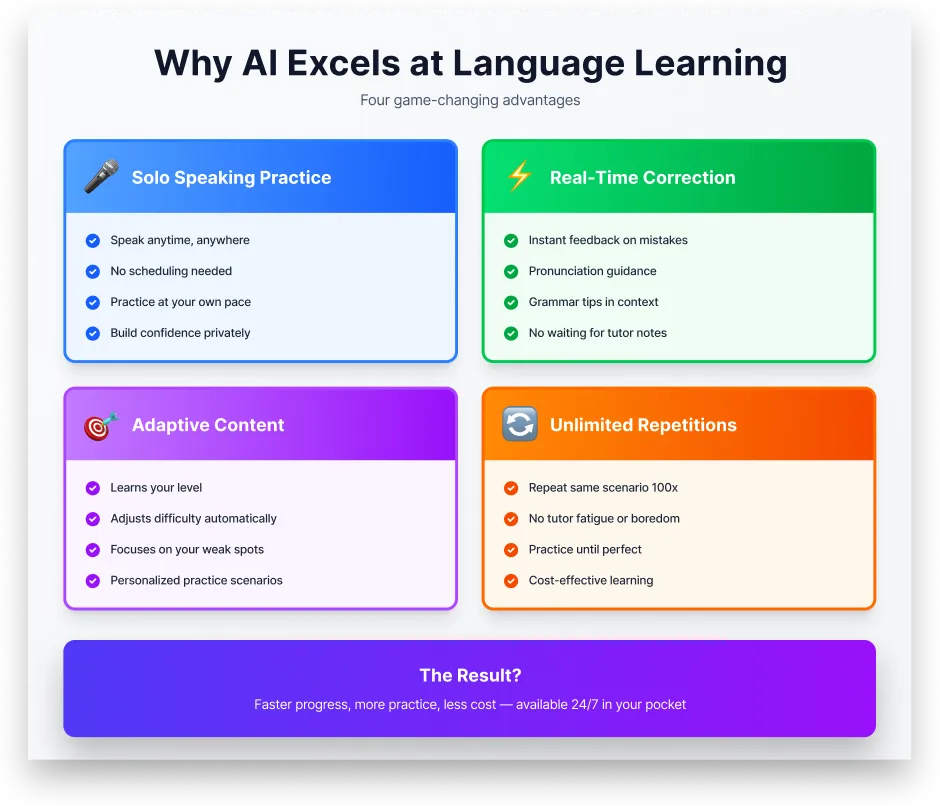
The 4 things AI does well in language learning
Every claim about AI in language learning either ties to one of these four, or it's hype. Use these as your filter.
1. Solo speaking practice
The biggest unlock. Until 2023, the only way to practice speaking was to find a partner — paid tutor, language exchange, classmate. That's a real bottleneck for beginners who freeze when they speak and don't yet feel ready for a live human. AI conversation tutors solve it: you can speak Spanish, Russian, Italian, or any other supported language at any hour, in a low-pressure environment, with no one judging you. The reps you couldn't get before are now available daily.
2. Real-time correction with explanations
A good AI tutor doesn't just say "wrong, try again." It tells you what you got wrong (case ending, verb aspect, ser vs estar, gender agreement) and why. That feedback loop — speak, get specifically corrected, try again, get it right — is the same loop that drives skill acquisition in sports or music. AI is the first technology that delivers it for language at scale.
3. Adaptive content and difficulty
Static courses can't adapt. AI can. A modern AI tutor watches what you handle well and what you trip on, and adjusts: more reps on the case you're missing, harder roleplays once you've mastered the basics, lower difficulty on a tired Monday. You stay in the productive struggle zone — not too easy, not crushing.
4. Unlimited reps at near-zero marginal cost
A human tutor at $30/hour, 5 days a week, costs $7,800 per year. An AI tutor delivers more daily reps for a fraction of that. The economics matter: most learners can't afford a daily human tutor; they can afford a daily AI tutor. Lower cost per rep means more reps means faster progress.
The 3 things AI still does poorly
Honest about the limits matters too. AI isn't magic.
- Long-term motivation. AI doesn't text you to ask why you missed two days. It doesn't remember your goals next month. Accountability is still mostly on you (or a human coach).
- Real-world unpredictability. Native speakers interrupt, mumble, switch dialects, joke. AI tutors are getting closer, but real conversation in a noisy market in Mexico City or Naples is still rougher than anything an AI will throw at you. You have to graduate to real humans eventually.
- Deep cultural nuance. Tone, register, when to use formal vs informal, what jokes land — AI handles the language, but high-fluency cultural fluency still benefits from real human exposure.
The takeaway: AI is the best daily-practice tool ever built. It's not the only tool you'll need.
The AI conversation tutor — the highest-leverage AI tool for language learning
Of all the things "AI for language learning" can mean, one stands out: the AI conversation tutor. It is the tool that closes the speaking gap that solo apps have always failed at.
What to look for in an AI language tutor in 2026:
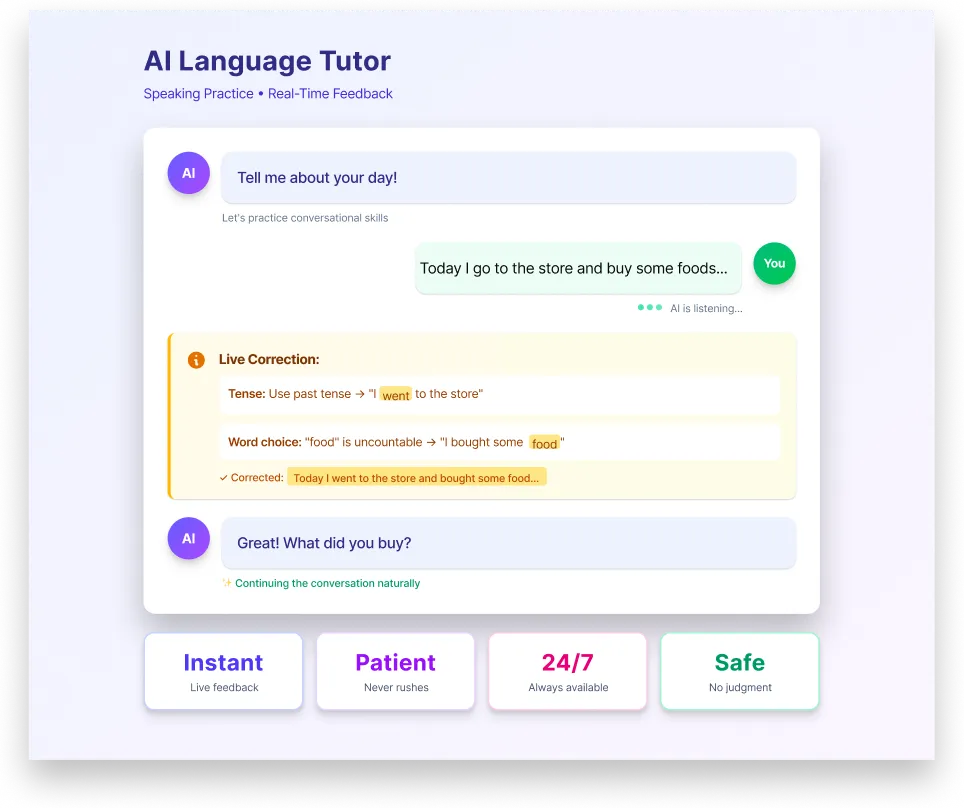
- Real-time voice response, not chat. You speak, it speaks. If you're typing, you're not training the muscle that matters.
- Specific corrections. Not "incorrect" — but "incorrect verb conjugation: hablo should be habla in third person."
- Roleplays you'll actually face. Restaurant, work meeting, asking directions, introducing yourself. Not abstract grammar drills.
- Adaptive difficulty. It should make week 4 harder than week 1.
- Multi-language support if you'll learn more than one.
Enverson AI's AI tutor is built around exactly this stack: speaking-first practice with live correction, structured roleplays, and adaptive difficulty — designed specifically to break learners out of the silent-learner phase. Pair it with one course and a vocabulary deck and you have everything a self-learner needs to reach conversational level in a new language. It's an example of AI for language learning done right: AI used for output and feedback, not for re-skinning flashcards.
How to use AI for language learning — a daily routine that works
Forget the 2-hour-Saturday plan. Build a 30-minute daily routine and protect it.
- 15 minutes — speaking with an AI tutor. Highest leverage. Never skip. Roleplay, free conversation, narrate your day. Whatever produces output.
- 10 minutes — vocab via spaced repetition. Frequency-ordered deck (top 1k or 2k words for your target language). LLMs can help you generate example sentences for stubborn words.
- 5 minutes — comprehensible input. A YouTube video, podcast, or song in your target language. AI tools can transcribe and translate on the fly when you get stuck.
That's it. Three blocks, 30 minutes, every day. Most "AI for language learning" advice over-complicates this. The simple stack works because it covers the three core skills — output, retention, input — every day.
Common AI-for-language-learning traps to avoid
Most learners who feel like AI "didn't work for them" fell into one of these:
- Treating AI as a fancier flashcard. If you only use AI for vocab quizzes, you're using 5% of its value. The speaking part is the unlock.
- Switching tools every week. AI app fatigue is real. Pick one tutor and one course; commit for 30 days minimum.
- Skipping the daily speaking block. This is the entire point. If you skip it, you're back to silent learning.
- Believing "AI will make you fluent in 30 days." It won't. AI compresses the timeline; it doesn't eliminate it. Conversational in weeks, fluent in months — those are honest targets.
- Never graduating to humans. AI is the warm-up. At some point you need real conversations with native speakers — find a partner, take a class, travel. AI gets you to the door; humans walk you through.
Do this / skip that
| Do this | Skip this |
|---|---|
| Speak daily with an AI tutor | Using AI only for grammar quizzes |
| One AI tool, committed for 30 days | App-hopping every week |
| Frequency-ordered vocab + AI example sentences | Themed vocab lists in isolation |
| Track weekly minutes spoken | Daily streak anxiety |
| Graduate to real humans after 8–12 weeks | Treating AI as the entire plan |
| Honest expectations: conversational in weeks | "Fluent in 30 days" promises |
Frequently asked questions
What is AI for language learning?
AI for language learning is the use of large language models, real-time speech recognition, and voice synthesis to enable things older language apps couldn't do — most importantly, daily solo speaking practice with real-time correction. In 2026, "AI for language learning" almost always refers to AI conversation tutors, adaptive learning platforms, and LLM-driven feedback tools, rather than the gamified flashcard apps that dominated the previous decade. The defining shift is from consumption (read, drill, watch) to production (speak, get corrected, repeat) — which is the bottleneck older tools never solved.
How does AI help language learning?
AI helps language learning in four specific ways: it enables solo speaking practice with no human partner needed, gives real-time corrections that explain what and why (not just "incorrect"), adapts difficulty to your level so you stay in the productive zone, and provides unlimited daily reps at near-zero marginal cost. The biggest of these is solo speaking practice — the single most important skill for fluency, and the one that solo apps and self-study never solved before 2023. AI closes that gap better than anything else available.
What is the best AI for language learning?
It depends on which gap you're trying to close. For daily speaking practice — the highest-leverage activity — an AI conversation tutor like Enverson AI is the right tool: speaking-first interaction, real-time correction, adaptive roleplays. For pronunciation drilling, dedicated apps work better than general LLMs. For grammar questions and example-sentence generation, an LLM chat works fine. The right move isn't picking one "best" AI; it's stacking 1–2 tools that match your goal and committing to one of them as your daily driver for at least 30 days.
Can AI replace a language tutor?
For daily reps, yes — and that's the part most learners need most. AI tutors give you 5–7 sessions a week at a price point human tutors can't match. For accountability, long-term motivation, and the deep cultural and conversational nuance that comes with a real human relationship, no — AI doesn't replace a human there. The best stack for most adult learners is AI tutor for daily speaking practice (5 days/week) plus a human tutor or conversation partner for one weekly session at a higher level. AI handles the volume; humans handle the high-value reps.
Is AI for language learning effective?
Yes — but only when used for output, not just consumption. The learners who say AI didn't work for them almost always used it as a fancier flashcard app. The learners who use AI for daily speaking practice — talking, getting corrected, talking again — see real progress in weeks, not years. The mechanism is reps with feedback, the same mechanism behind every skill humans get good at. AI is the first tech that delivers it for languages at scale. Use it for speaking and you'll find it deeply effective. Use it as a passive content stream and it won't be.
Related articles
Use AI the way it actually works.
Daily speaking practice with Enverson AI's AI tutor is the highest-leverage AI use in language learning.
Try Enverson AI Free