For most of the history of language learning, there was one problem nobody could design their way around: you could not practise speaking on your own. You could read alone, write alone, and listen alone. But the moment you wanted to actually talk, you needed another human being to be free, willing, patient, and in the same time zone. That was the bottleneck. It is why so many learners could read a newspaper in their target language and still freeze at a hotel desk. AI has now removed that bottleneck — genuinely, not as a marketing claim. What follows is an honest account of what that does and does not mean, because "AI replaces human tutors" is too blunt a statement to be true, and "AI can never replace a human" is too comfortable a statement to be useful.
Before AI: the practice-partner bottleneck
Think about what solo practice used to look like. You had textbooks, audio courses, flashcards, and grammar drills — all of which you could do at 11pm on a Tuesday with nobody's permission. Then you hit the wall. Speaking required a partner, and partners are expensive in every sense: money, scheduling, social energy, and the quiet embarrassment of asking a friend to sit through your fourth attempt at the same sentence.
The workarounds were all compromised. Language exchange partners were free but unreliable, and half the session went to their language rather than yours. Conversation clubs met once a week at a fixed hour. One-to-one tutors were excellent and priced accordingly, which meant most learners could afford perhaps one hour a week. And an hour a week is simply not enough volume to build a motor skill — because that is what speaking is. It is closer to playing an instrument than to memorising facts.
So the typical learner arrived at a very familiar place: strong passive knowledge, weak active production. They understood far more than they could produce, and the gap widened because the only cure for it — talking — was the one thing they could not do on demand.
That is the constraint AI has broken. Not "improved". Broken. The requirement that another person be available before you can practise speaking no longer exists. You can now have a real spoken exchange at 6am, at midnight, on a train, or in the ten minutes before a meeting, with something that responds intelligently and corrects you as you go.
Speaking on demand, without arranging anything
An Enverson AI session starts when you decide it starts. No booking, no cancellation policy, no waiting for someone to come online. The AI tutor listens, replies, and steers the conversation toward the structures you have not yet mastered — which is precisely what a practice partner was for, minus the logistics that made partners scarce.
What "replace" actually means — two different jobs
Most arguments about this question go wrong in the first sentence, because "human tutor" describes two jobs that happen to be performed by the same person. Separate them and the answer becomes clear.
Job one: the conversation partner. Someone to talk to, who responds in the target language, who corrects obvious errors, who keeps a conversation going when you stall, and who does not switch to your native language out of politeness. This job is largely automatable, and in 2026 it has largely been automated. An AI tutor does it at any hour, indefinitely, at a fraction of the price.
Job two: the teacher and mentor. Someone who diagnoses why you are stuck, who knows from experience which explanation lands for which kind of learner, who tells you the cultural reason a phrase sounds cold, who notices you have gone quiet because you are discouraged rather than confused, and whom you feel accountable to. This job is not automated. Parts of it are being encroached upon, but the whole of it is not close to being replaced.
So the accurate statement is this: AI has replaced the practice partner, and has not replaced the teacher. For a large number of learners — arguably the majority — the practice partner was the binding constraint, not the teacher. They did not lack explanations; explanations are abundant and free. They lacked reps. If reps were your bottleneck, AI has effectively removed your dependency on another human. If mentorship and accountability were your bottleneck, it has not.
If you want the head-to-head version of this argument — cost, speed, personalisation and outcomes weighed against each other — we cover that separately in AI vs human tutors: which is better for learning English. This article is about a different question: not which is better, but what can actually be replaced.
Where AI genuinely outperforms a human tutor
There are specific, mechanical ways in which an AI tutor does the job better — not marginally, but categorically. These are not opinions about teaching philosophy; they are consequences of how software differs from a person.
It remembers every mistake you have ever made. This is the big one, and it is underrated. A good human tutor remembers that you struggle with the present perfect. They do not remember that on 14 March you said "I am agree", on 2 April you said "I am agree with him", and on 19 June you avoided the construction entirely by rephrasing. No human can hold that volume of detail about one student, and a tutor with thirty students certainly cannot. Enverson AI keeps a long-term memory of your errors across every session and quietly re-drills them until they stop appearing. Nothing you get wrong is lost between lessons.
It corrects mid-sentence. A human tutor generally waits for a natural pause, partly out of politeness and partly because interrupting constantly would be unbearable. The cost of waiting is that the correction arrives after the error has already been rehearsed. An AI tutor can flag the mistake at the moment it happens, with a short explanation and the correct version to repeat back, and it can do so without any social awkwardness. We go deeper into that mechanism in our piece on the AI English learning app that corrects your mistakes.
It never gets tired, bored, or impatient. Repetition is how speaking becomes automatic, and repetition is socially expensive with a person. Most learners will not ask a tutor to hear the same sentence a tenth time, because they can sense the tutor's patience thinning — or they imagine they can, which has the same effect. An AI has no patience to exhaust, and crucially, you know it does not. The self-consciousness that suppresses practice simply is not there.
It personalises at a depth no human can sustain. Enverson AI's Multidimensional Personalization Engine tracks not just your level but your error patterns, your vocabulary range, your speaking pace, your recurring hesitations, and how you respond to different kinds of correction. A human tutor personalises brilliantly within a session, from intuition. Sustaining that across months, across every dimension, for every student, is not something a person can do.
It measures each skill separately. "You're improving" is what a human can honestly tell you. A per-skill breakdown of grammar accuracy, vocabulary growth, pronunciation, and fluency over time is what software can tell you. The second is more useful when you are deciding what to work on next week.
It costs a fraction of one-to-one lessons. This matters less as a saving and more as a change in what is possible. At tutor prices, daily practice is a luxury. At AI prices, daily practice is the default. Since frequency is the main driver of speaking progress, the price difference quietly changes the shape of the whole learning plan.
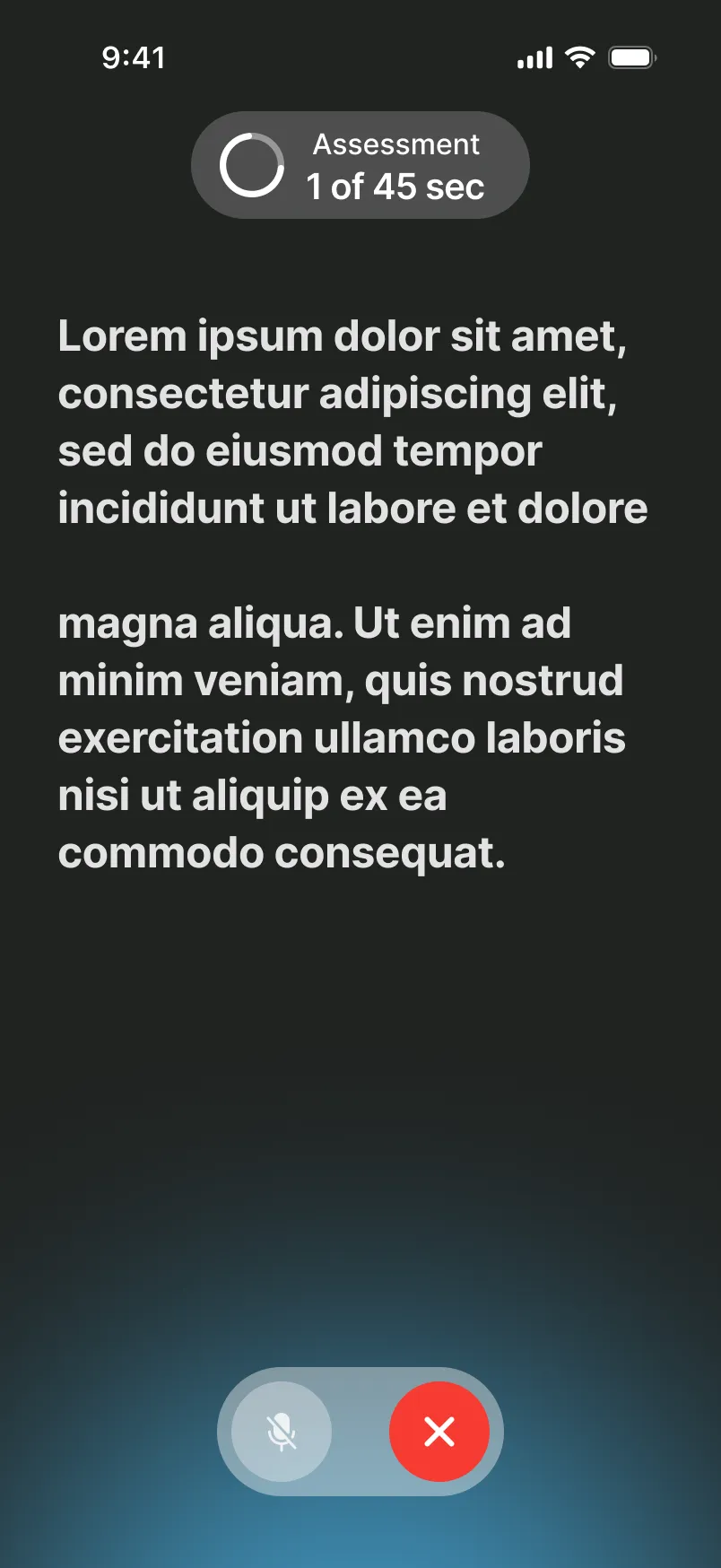
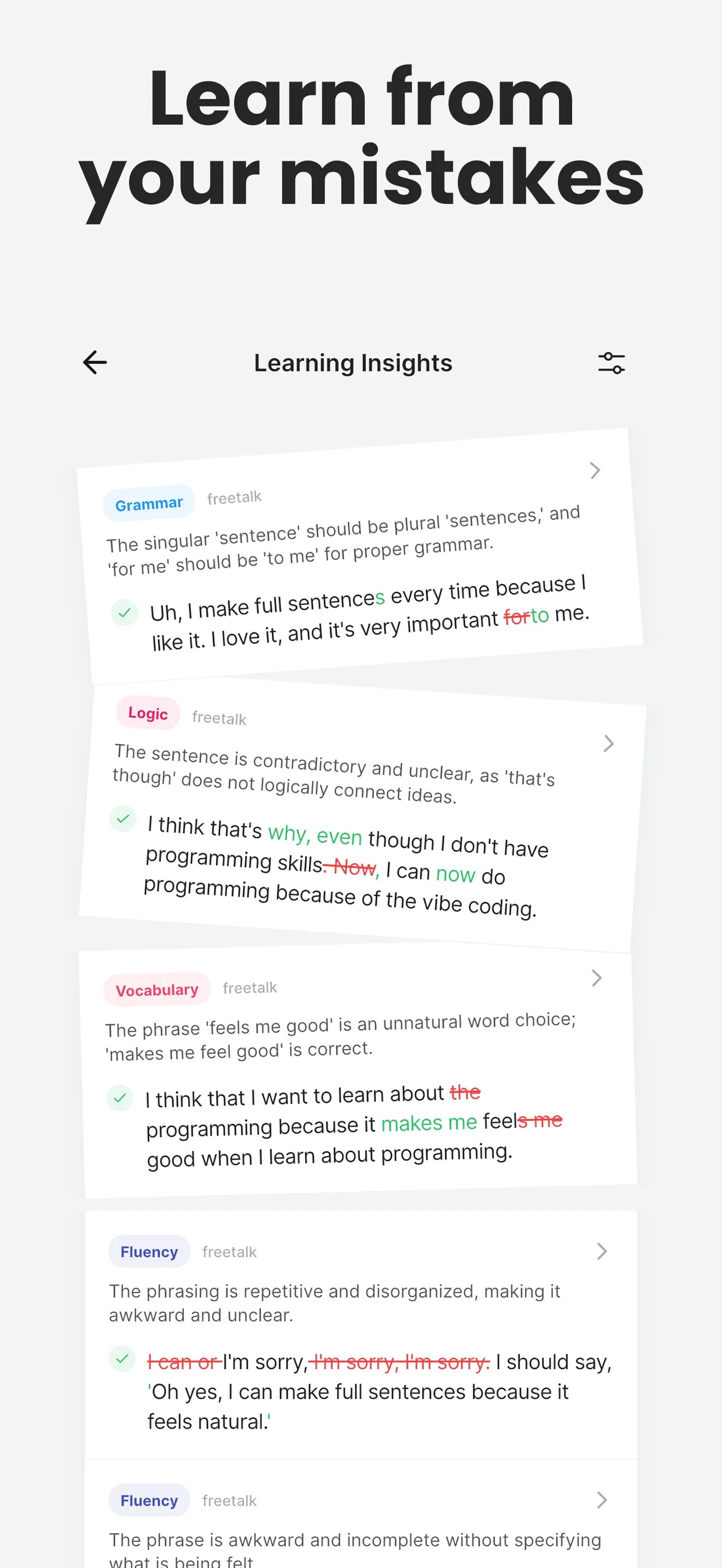
Correction the moment it happens
Grammar, vocabulary and pronunciation errors are surfaced in-session, with a brief explanation and the correct version to say back. The error then enters long-term memory, so a mistake you made three weeks ago reappears as a target in a later session rather than quietly persisting.
Where human tutors still win — honestly
It would be easy to stop at the previous section and declare the matter settled. It is not settled, and pretending otherwise would be dishonest. Here is what a good human tutor still does better.
Lived cultural context. A person who has actually lived somewhere knows things that are not documented anywhere: which phrase sounds sarcastic in one region and neutral in another, what a particular silence means in a meeting, why a formally correct sentence would still get you a strange look. AI can describe cultural rules. A person who has lived them explains them differently, and with more reliable judgement about edge cases.
Emotional accountability. This is probably the single biggest human advantage. Some learners need another person to be expecting them. A booked lesson creates obligation; an app does not. A tutor who notices you sound flat and asks what is going on, then adjusts the lesson accordingly, is doing something an AI can imitate but not fully deliver. If you are the kind of learner who has abandoned four apps, the human is not a luxury — it is the mechanism that keeps you in the game.
Reading a room and negotiating meaning. When a real conversation goes sideways — a misunderstanding compounds, someone takes offence, the topic turns genuinely complex — a skilled teacher navigates it and turns the wreckage into a lesson. That kind of repair work, done live, remains a human strength.
Exam coaching with human judgement. For IELTS, TOEFL, or a professional certification, an experienced teacher's sense of exactly where you will lose marks, and what the examiner is actually listening for, is hard to reproduce. Software can drill the format. A teacher who has marked hundreds of these knows things about the format that are not in the format.
Social pressure that produces attendance. Related to accountability but worth stating separately: paying for a lesson makes people show up. That is not pedagogy, it is psychology, and it works. Any honest comparison has to concede that a mediocre lesson you attend beats an excellent practice session you skip.
AI tutor vs human tutor: what each actually replaces
| Dimension | AI tutor | Human tutor | Replaceable? |
|---|---|---|---|
| Conversation practice on demand | Any hour, unlimited, no booking | Scheduled, 1–3 sessions a week | Yes — largely replaced |
| Memory of your past mistakes | Complete, persistent across all sessions | Impressionistic, fades between lessons | Yes — AI is stronger |
| Correction timing | Mid-sentence, no social cost | Usually deferred to a natural pause | Yes — AI is stronger |
| Unlimited repetition without judgement | Infinite, no self-consciousness | Socially limited in practice | Yes — AI is stronger |
| Per-skill measurement | Tracked and charted over time | Qualitative judgement | Yes — AI is stronger |
| Cost of daily practice | Affordable at daily frequency | Prohibitive at daily frequency | Yes — AI is stronger |
| Lived cultural nuance | Described, not lived | First-hand, with judgement on edge cases | No — human still wins |
| Emotional accountability | Reminders and streaks only | A real person expecting you | No — human still wins |
| Complex repair of misunderstanding | Handles most cases, not all | Reads the room and recovers | No — human still wins |
| High-stakes exam coaching | Drills format and timing well | Knows where marks are actually lost | Partly — human still preferred |
The self-study learner: where AI really does replace the human
Now to the group this question actually matters most for. Some people learn better alone. They do not want a scheduled hour, they do not want small talk before the lesson, and they do not want to perform competence for an audience while they are still building it. They want to work at their own pace, repeat what they choose, and stop when they are done. If that describes you, the honest conclusion is that AI has removed your need for a human practice partner almost entirely.
And self-study, done consistently, is often the more effective path — not the compromise it is usually treated as. Three reasons.
It is available every day. Fluency responds to frequency far more than to session length. Twenty minutes daily beats ninety minutes weekly, and always has. The historical reason people did not do the daily version is that they could not: there was nobody to talk to. That reason has expired.
It moves at your pace. In a lesson, the pace is a negotiation. Alone, you can spend forty minutes on one stubborn construction, or skip ahead when something clicks immediately. Nobody is waiting, so nothing is wasted.
It removes scheduling friction, which is where most learning plans die. Every step between deciding to practise and practising is a place to quit. Booking, confirming, joining a call at a fixed time, rearranging when work overruns — each is small, and collectively they are why so many people stop. Removing them is not a convenience feature. It is the difference between a plan that survives a busy month and one that does not.
We have written more on how these two approaches compare in AI-based English learning vs self-study. The short version: the old objection to self-study was that you could not practise speaking alone. That objection no longer holds, and everything self-study was always good at now applies to speaking too.
And when you do want humans — live voice rooms
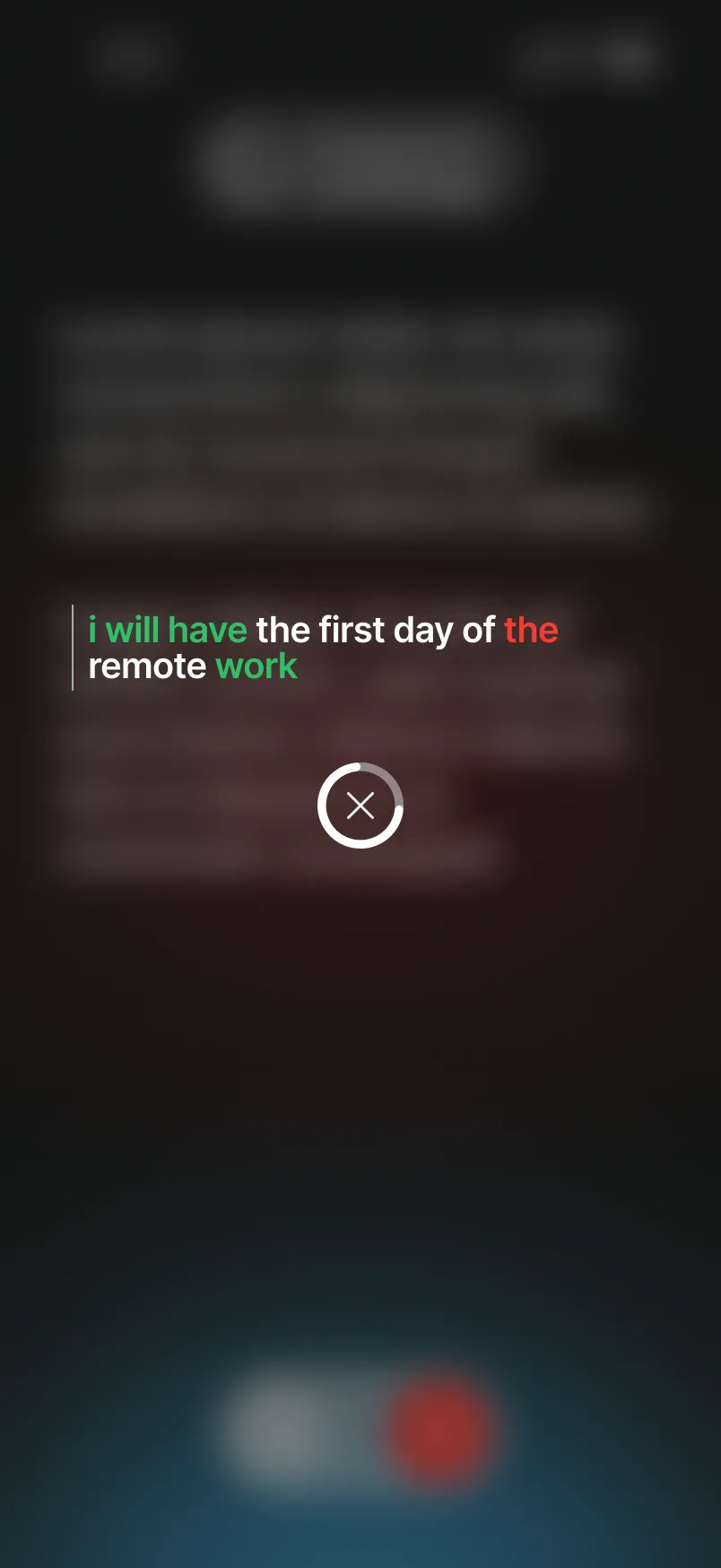
Self-study does not have to mean isolation. Enverson AI's Combo live-matching feature pairs you with other real learners at your level for AI-moderated group practice. You get genuine human unpredictability, without arranging anything and without a partner who quietly switches to your native language.
What Enverson AI actually does in place of a tutor
Claims about replacement are only worth anything if the functionality is specific. Here is what is actually doing the work.
The tutor is agentic, not a chat wrapper — it holds a goal for the session, steers toward the structures you avoid, and decides what to drill next based on your history rather than waiting for you to pick a topic. Real-time correction covers grammar, vocabulary and pronunciation in-session. Long-term memory stores every error you make and re-drills it later, which is the mechanism that most directly substitutes for a tutor who "knows your weak points" — except it knows all of them, permanently. The Multidimensional Personalization Engine adapts across level, error patterns, pace and learning style at once.
Beyond one-to-one practice, live voice rooms (the Combo live-matching feature) put you in AI-moderated group conversation with other real learners at your level. Real-world role-play scenarios cover the situations people actually freeze in — job interviews, hotel check-in, a doctor's appointment, a salary negotiation — with the AI playing the other side until it stops feeling like a script. The personalized fluency dashboard reports per-skill progress rather than a streak. And six dedicated AI agents — Grammar, Fluency, Writing, Listening, Reading and Vocabulary — cover the skills a single tutor would otherwise have to juggle in one hour a week.
Worth noting what this is not: it is not a general-purpose chatbot. If you want the distinction spelled out, see Enverson AI vs ChatGPT for learning English. A general model will talk to you; it will not place your level, follow a curriculum, remember your errors across months, or measure anything.
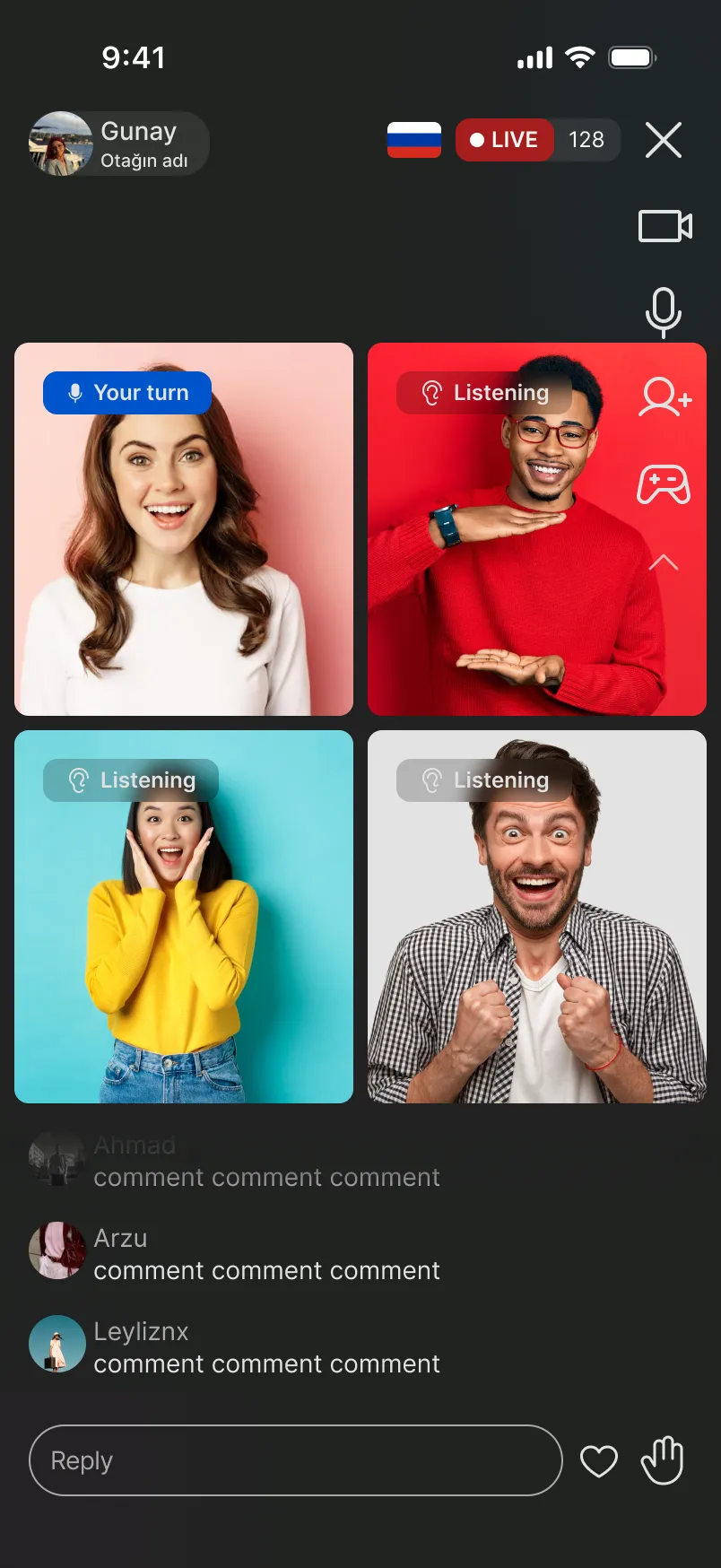
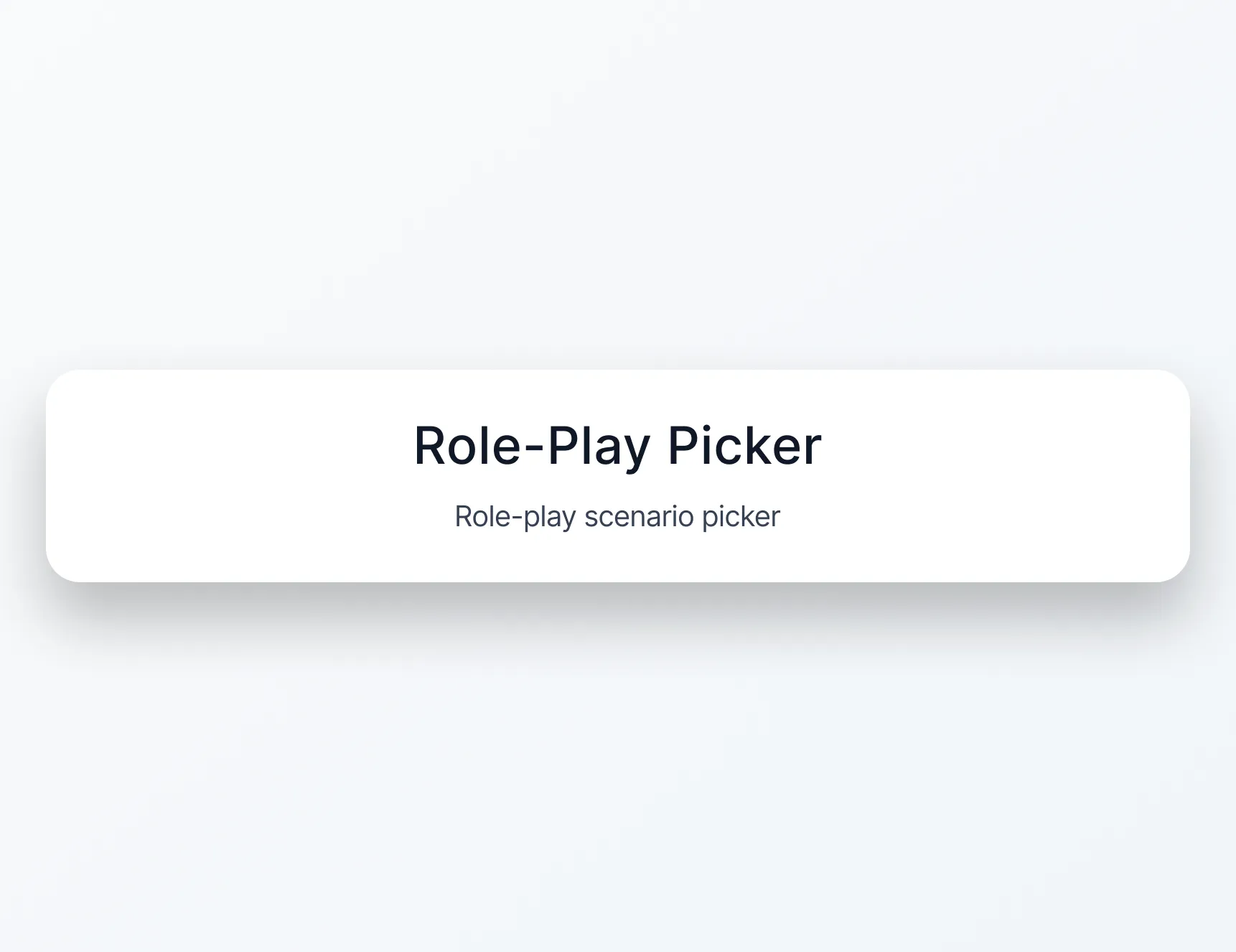
Rehearse the conversations that actually matter
Job interview, hotel check-in, doctor visit, salary negotiation — the scenario library targets the moments where learners lose their nerve. The AI plays the other side and coaches you through it, so the first time you handle it for real is not the first time you have handled it.
The hybrid model: AI daily, human occasionally
For learners with high-stakes goals and the budget to match, the strongest configuration is not either-or. Use AI daily for volume, correction and error-drilling. Book a human occasionally — monthly, or fortnightly in the run-up to an exam — for cultural feedback, exam strategy, and an outside read on your progress. The AI does the reps; the human does the coaching. It is a sensible division of labour, and it uses each for what it is genuinely better at.
The failure mode to avoid is the reverse: a weekly lesson and nothing in between. That is the arrangement most learners default to, and it is the least effective use of both. An hour a week cannot supply the frequency speaking requires, and without daily practice there is little for the tutor to correct beyond the same errors, week after week. If your budget only stretches one way, put it into daily practice first.
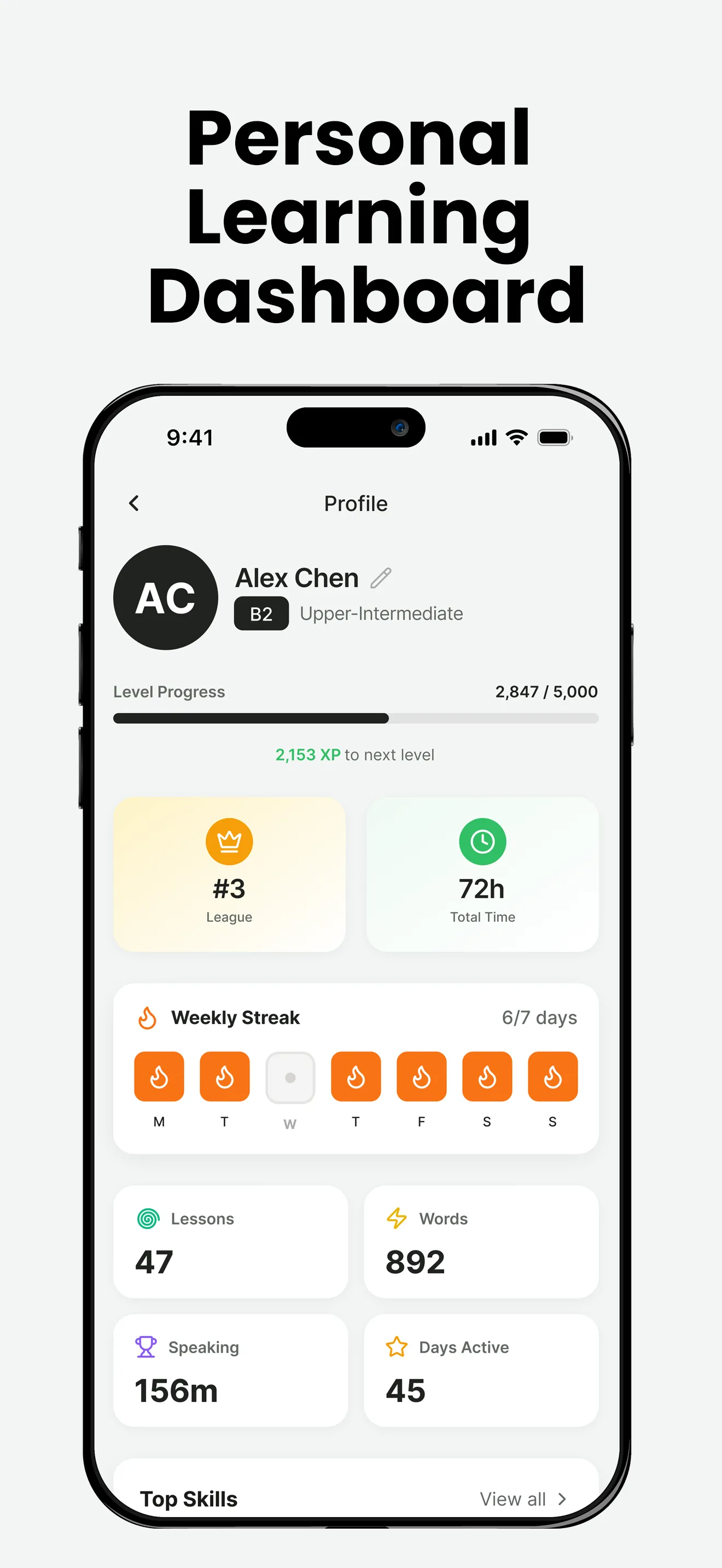
Progress you can actually inspect
The fluency dashboard breaks out grammar accuracy, vocabulary growth, pronunciation and speaking pace over time, fed by six dedicated agents. It answers the question a weekly lesson rarely can: what specifically improved, and what has not moved in a month.
A decision framework
Choose AI-only if:
- You prefer self-study and dislike scheduled sessions
- Your bottleneck is speaking volume, not understanding the rules
- You want to practise daily rather than weekly
- You are self-motivated and do not need someone expecting you
- You feel self-conscious repeating yourself in front of a person
- Your goal is conversational and professional fluency rather than a specific exam band
- Budget matters and you would rather have daily practice than one hour a week
Keep a human tutor if:
- You are preparing for a high-stakes exam with a scoring rubric
- You need accountability — you have started and abandoned apps before
- Your goal depends heavily on cultural fluency in a specific country or workplace
- You genuinely enjoy the relationship, which is a legitimate reason on its own
- You need advocacy — a reference, an assessment, or a formal certification
Do both if: the goal is high-stakes and the budget allows. AI daily for reps, a human monthly for coaching. If you are still weighing tools before committing, our 2026 review of the best AI language learning apps compares the field.
The verdict
Can AI language tutors replace human tutors? Not completely — and any product telling you otherwise is selling rather than explaining. But that framing hides the more interesting truth. The thing that stopped most people from becoming fluent was never a shortage of teachers. It was the impossibility of practising speaking alone. That constraint defined language learning for a very long time, and it is gone.
What remains human is real: cultural depth, accountability, judgement under pressure, and the simple fact that some people need another person in the room. What has been replaced is also real, and it is the part that was blocking most learners. If you are a self-study learner, you no longer need to wait for anyone. That is not a smaller claim than "AI replaces tutors". For most people, it is the bigger one.
Frequently asked questions
Can AI language tutors completely replace human tutors?
No — not completely, and anyone claiming otherwise is overselling. AI has genuinely replaced the human practice partner: you no longer need another person to be free at the same time as you in order to speak. But it has not replaced the teacher or the mentor. Cultural nuance, emotional accountability, exam coaching that relies on human judgement, and the social pressure that makes some learners actually show up are still human strengths. The honest answer is segmentation, not replacement: for self-study learners, AI removes the dependency almost entirely; for learners who need a person to hold them to it, a human still matters.
What can an AI tutor do better than a human tutor?
Several things, measurably. An AI tutor remembers every mistake you have ever made across every session — a human tutor cannot hold that volume of detail about one student, let alone thirty. It corrects mid-sentence rather than waiting for a polite pause. It is available at 6am and at midnight. It never gets tired, impatient, or visibly bored when you repeat the same sentence for the tenth time. It measures each skill separately and shows you the trend. And it costs a fraction of one-to-one lessons, which means daily practice is affordable rather than a luxury.
What do human tutors still do better than AI?
Human tutors still win on lived cultural context — the things a person knows from having actually lived somewhere. They win on emotional accountability: a person who notices you are discouraged and adjusts, and whom you feel obliged to show up for. They win on reading a room and negotiating meaning when a conversation goes genuinely sideways. And for high-stakes exam coaching, an experienced teacher's judgement about where you will lose marks remains hard to reproduce.
Is self-study with AI actually effective for speaking?
Yes, and for many learners it is the more effective path — precisely because it removes scheduling friction. Speaking improves with frequency more than with session length, and a weekly lesson simply cannot deliver frequency. Self-study with an AI tutor is available every day, moves at your pace, and lets you repeat anything as often as you like without an audience. Done consistently, that compounds faster than one polished hour a week. The historical problem with self-study was that you could not practise speaking alone; that constraint is what AI has removed.
Should I use AI and a human tutor together?
That is the strongest setup if you can afford it and your goal is high-stakes — an exam, a visa interview, a professional relocation. Use AI daily for volume, correction, and drilling your recurring errors, and book a human occasionally for cultural feedback, exam strategy, and a reality check on your progress. The AI does the reps; the human does the coaching. If budget is limited, put the money into daily AI practice first: frequency is what moves fluency, and an occasional lesson without daily practice rarely gets anyone speaking.
You no longer need to wait for anyone
The practice partner was the bottleneck. It is gone. Start speaking today — with an agentic AI tutor that remembers every mistake you make, and with real learners in live voice rooms when you want them.
Try Enverson AI Free