You can tell a company's English training for employees isn't working when the same people who passed the placement test still go quiet the second a meeting switches to English. The licenses are paid for, the lessons are completed, the dashboards look fine — and nobody is speaking. This playbook is for the HR and L&D leaders who recognize that and want to fix it without buying yet another tool.
It covers what to actually target, the four delivery modalities and where each fits, how to design a 90-day program, what to measure, and the buyer's checklist for picking an employee language training platform that won't disappoint a year later.
Why generic consumer apps fail at work
Consumer language apps are designed for individual habit. They optimize for streaks, lesson counts, and short-session retention. None of those metrics translate into an employee who can run a discovery call in English or de-escalate an angry customer.
The gap is structural, not motivational. Employees say it themselves: "Apps don't help me speak." A consumer app gives them taps and matching exercises; what they need is reps — actual speaking, with actual feedback, with actual humans where possible. The job of English training for employees is to close that loop, and a consumer-only program almost never does.
The 4 outcomes English training for employees should target
If your program isn't producing these four outcomes, no amount of platform-shopping will save it.
- Placement-anchored level shift. Every employee starts with a real placement test (CEFR-aligned), gets a personal goal, and is re-tested at 90 and 180 days. Without this, "improvement" is anecdotal.
- Speaking confidence in role-relevant scenarios. Sales reps practice discovery and demo English. Support reps practice empathy and de-escalation English. Engineers practice standup and design-review English. Generic "business English" is too vague.
- Retention. A program that 80% of employees abandon by week six wasn't a program. Cadence, manager visibility, and low-friction practice (one click to start) are what hold the line.
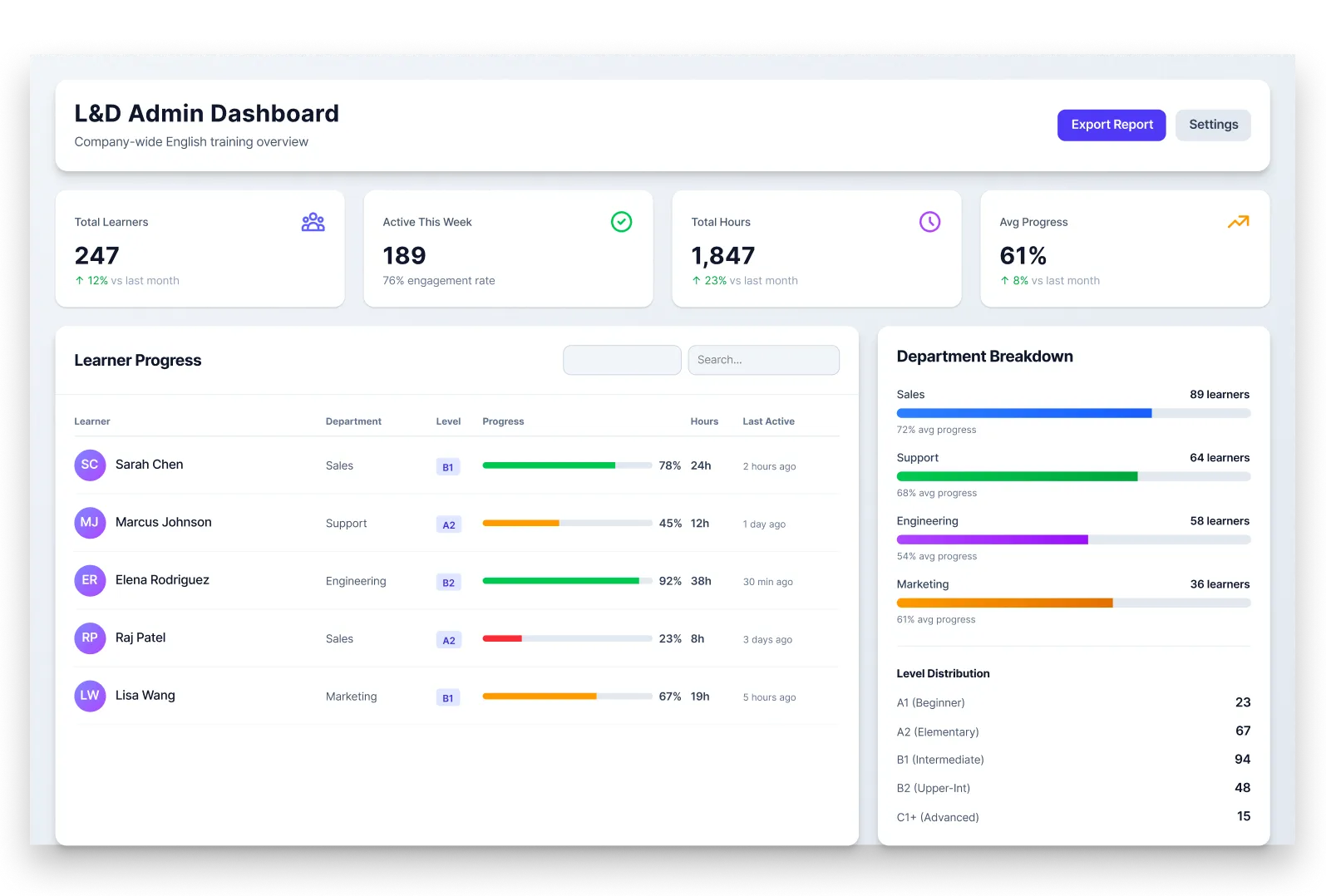
- Measurability. HR needs numbers leadership can read: average speaking minutes per week per employee, level shifts per quarter, manager-rated meeting participation, and language-related impact on customer-facing KPIs.
The 4 modalities and where each fits
There is no single right format. There are four useful ones, each with a clear best-use case.
| Modality | What it is | Best for | Real cost driver |
|---|---|---|---|
| AI English training for companies | App + AI partner for daily speaking practice, often with voice rooms for peer practice | Distributed teams that need volume of speaking reps; large rollouts where consumer apps already failed | Per-seat platform fee; low marginal cost per extra rep |
| Live group classes | Scheduled cohorts with a teacher, usually 60–90 min, 1–2× per week | Cohorts in the same time zone who benefit from social pressure and a shared schedule | Teacher hours; falls apart at distributed scale |
| 1:1 coaching | A dedicated tutor per employee, booked on-demand or recurring | High-leverage individuals (executives, top-of-funnel sales, customer-facing leaders) | Tutor hours; expensive at scale, excellent for the right people |
| Hybrid | App-led daily practice + occasional live group or 1:1 | Most mid-to-large workforces — daily reps from AI/peer, periodic live for accountability | Mix of platform + coach hours; usually best ROI overall |
A common mistake: buying live-only programs at distributed scale. They produce the cleanest LinkedIn posts and the lowest weekly speaking minutes. A common save: pairing AI English training for companies with one or two live touchpoints per month for accountability.
How to design the program — placement → goal → cadence → measurement
A workable program has four moving parts and almost nothing else.
1. Placement. Run a CEFR-aligned placement test for everyone in scope at week zero. Without this you can't show progress later. Most serious B2B platforms include one; if yours doesn't, that's a red flag.
2. Goal per employee, not per company. "Improve company English" is a slogan, not a goal. "Maria — discovery calls without freezing by week 12" is a goal. Tie the goal to a real role outcome the employee and their manager both care about.
3. Cadence. Three short sessions a week (15–20 minutes of voice-on speaking practice) beats one long weekly class for almost every learner. Put the sessions on the calendar, manager-visible, with a clear definition of "done".
4. Measurement. Pre/post speaking assessment at 0, 90, and 180 days. Manager-reported observations every 30 days (one short form). Platform-side metrics (weekly speaking minutes, scenario completion). One leadership-readable dashboard, not five.
Choosing an employee language training platform — buyer's checklist
When evaluating any team-based English learning app or English training SaaS for business, ask vendors:
- How many minutes of voice-on speaking practice does an average employee complete per week after week 4?
- What's the placement test, and can we export pre/post results per employee?
- Does the scenario library include content for our specific roles (sales, support, engineering, leadership)?
- From open-app to talking, how many clicks?
- What does the manager view show, and can it be scoped to direct reports only?
- What's the SSO and admin onboarding timeline for our seat count?
- Is per-seat pricing published, and does it scale sensibly at our size?
- Which of your customers can we talk to who run a program like ours?
If the platform can't answer 1, 4, and 5 cleanly, the rest doesn't matter.
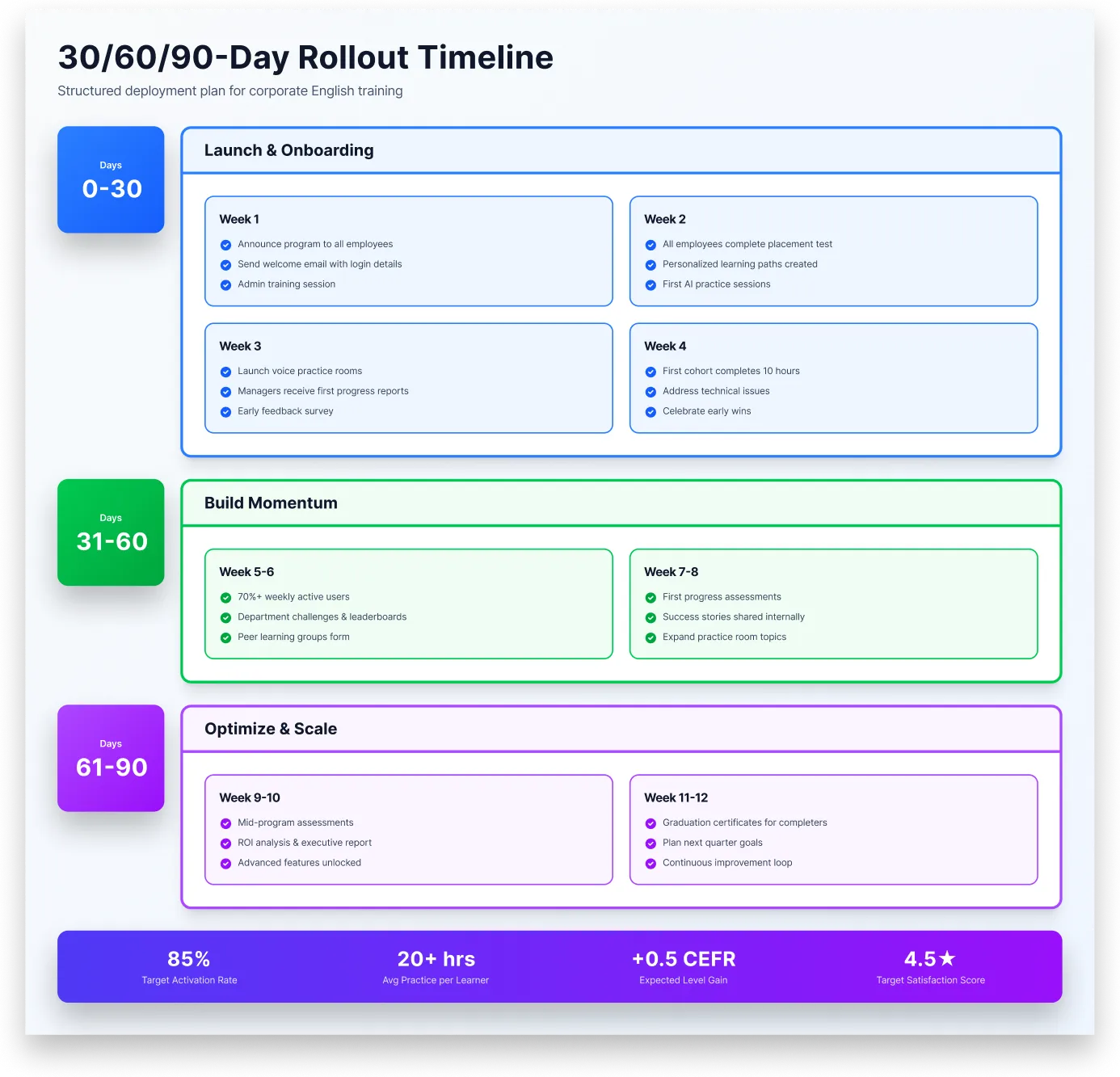
The 30 / 60 / 90-day rollout plan
Days 1–30 — Place and pilot. Pick a 20–40 employee pilot cohort spanning at least two roles. Run placement tests in week 1. Define one role-specific goal per employee. Launch practice in week 2. Assign a program owner inside HR/L&D who actually uses the tool weekly.
Days 31–60 — Habit and feedback. Manager-visible cadence: 3 sessions/week, 15–20 min each. Weekly 5-minute manager check-ins ("did Maria speak in standup this week?"). First retention review at day 45 — anyone below 50% adherence gets a one-on-one, not a removal.
Days 61–90 — Re-measure and expand. Re-run the speaking assessment. Capture manager observations. Compare against the role-specific goals. Pick the cohorts that move next (don't roll out to everyone at once — the point of a phased rollout is the lessons you learn each round).
After day 90, the program either has a real result (level shifts, manager-observed change, employee testimonials in their own words) or it doesn't. If it doesn't, the answer is almost never "buy a different platform" — it's almost always cadence, accountability, or program ownership.
How to measure results
Three signals, one dashboard:
- Speaking score (platform + assessment). Pre/post rubric scoring on clarity, pacing, vocabulary range, and grammar under pressure. The single most defensible metric for English speaking practice for employees.
- Manager observation. Short monthly form: "Did this employee participate more in English meetings this month than last?" 5-point scale. Anonymous rollups to leadership.
- Business signals. Sales: ramp time, discovery-call quality, demo win rate. Support: handle time, CSAT on English-language tickets. All-team: meeting participation, internal mobility into English-required roles.
Pick three numbers, not fifteen. Measure them every 90 days. Publish them.
Frequently asked questions
What is the best English training for employees in 2026?
The best English training for employees in 2026 is the format that produces the most weekly speaking minutes per learner, not the format with the most prestigious brand. For distributed and customer-facing workforces, that's almost always AI English training for companies — an app with an AI partner and peer voice rooms — combined with one or two live touchpoints per month for accountability. The single best predictor of program success is whether the employee actually speaks several times a week, and lighter, more frequent reps beat heavy weekly classes for most learners.
How much does English training for employees typically cost per seat per year?
It depends on the modality. Consumer apps with a corporate skin run roughly $80–$200 per seat per year. B2B English learning platforms with a real admin layer typically run $180–$600 per seat per year. 1:1 coaching programs run $600–$2,400 per seat per year and up. Hybrid programs land in the middle. Cost is mostly driven by how much human time is included; the platform layer itself is usually a small fraction of the bill. Don't anchor on price alone — anchor on cost-per-measured-level-shift, which is the only number leadership will care about a year later.
Can AI English training for companies replace a human teacher?
AI replaces the part of teaching that's actually a bottleneck — speaking reps and immediate feedback. A human teacher can only listen to one learner at a time and can't be available at 7 a.m. for someone in another time zone. AI can. What AI doesn't replace is goal-setting, accountability, and complex coaching for senior employees. The most effective programs use AI to carry daily speaking volume and use human teachers or coaches for periodic check-ins, executive support, and the moments where a learner is stuck on something only a human can unblock.
How do you keep employees consistent with English speaking practice for employees programs?
Consistency is built by removing friction, not by adding pressure. Three things move the needle: short reps (15–20 minutes, not 60+), calendar holds the manager can see, and a one-click path from open-app to actually talking — so 'I don't have anyone to practice with' stops being a valid excuse. Add a single weekly five-minute manager check-in tied to the employee's goal. Don't gamify with streaks; learners who already think 'I freeze when I speak' don't need another reason to feel behind.
How do you measure results from employee language training in 90 days?
Capture a baseline before the program starts: a CEFR-aligned speaking assessment scored against a clear rubric, plus a one-question manager observation. At day 90, re-run the same assessment and the same observation. Add platform metrics — weekly speaking minutes per employee, scenario completion, retention. For customer-facing roles, layer one business signal (call quality for sales, handle time and CSAT for support). Three measurements, one dashboard, every 90 days. That's enough to defend the program — or kill it — with real data instead of vibes.
Related articles
- Best English learning app for working professionals — Individual-skill view of the audience your program is for.
- Improve English speaking — Core skill outcome the program targets.
- How AI helps you practice real-life English conversations — Why AI speaking practice carries daily volume in modern programs.
- Why one-size-fits-all English learning fails — Justifies the per-employee personalization in this playbook.
Run an English program that actually speaks.
Stop paying for licenses no one uses — give employees the daily speaking practice that turns "I understand English" into "I run the meeting".
Try Enverson AI Free