A sales rep going into a discovery call, a support agent typing under chat SLA, and a backend engineer joining standup from another time zone all need English. They do not need the same English. The fastest way to waste a budget on English training for remote teams in 2026 is to assume one generic curriculum will land for all three.
This guide breaks down what each team actually needs, where the requirements overlap, and how to run one program across sales, support, and remote teams without watering it down for any of them.
What's the same across all three teams (and why generic training misses it)
The shared piece is small but non-negotiable: speaking confidence under time pressure. Every one of these roles has to talk, in English, in a window measured in seconds — a sales rep handling an unexpected objection, a support agent answering a complaint, a remote engineer asked to explain a regression on the spot.
Generic English training misses this because it teaches grammar and vocabulary in isolation, not under pressure. Employees go through the lessons, pass the quizzes, and still freeze. "I forget everything when I start talking" is the universal complaint, and the only fix is reps — real speaking practice in scenarios that match what they'll actually do at work.
English training for remote teams
Remote teams have one structural problem: time zones break synchronous training. A live class scheduled at 10 a.m. London leaves the São Paulo and Bengaluru members either skipping or attending half-asleep. Within a few weeks, attendance drops below the threshold where the program means anything.
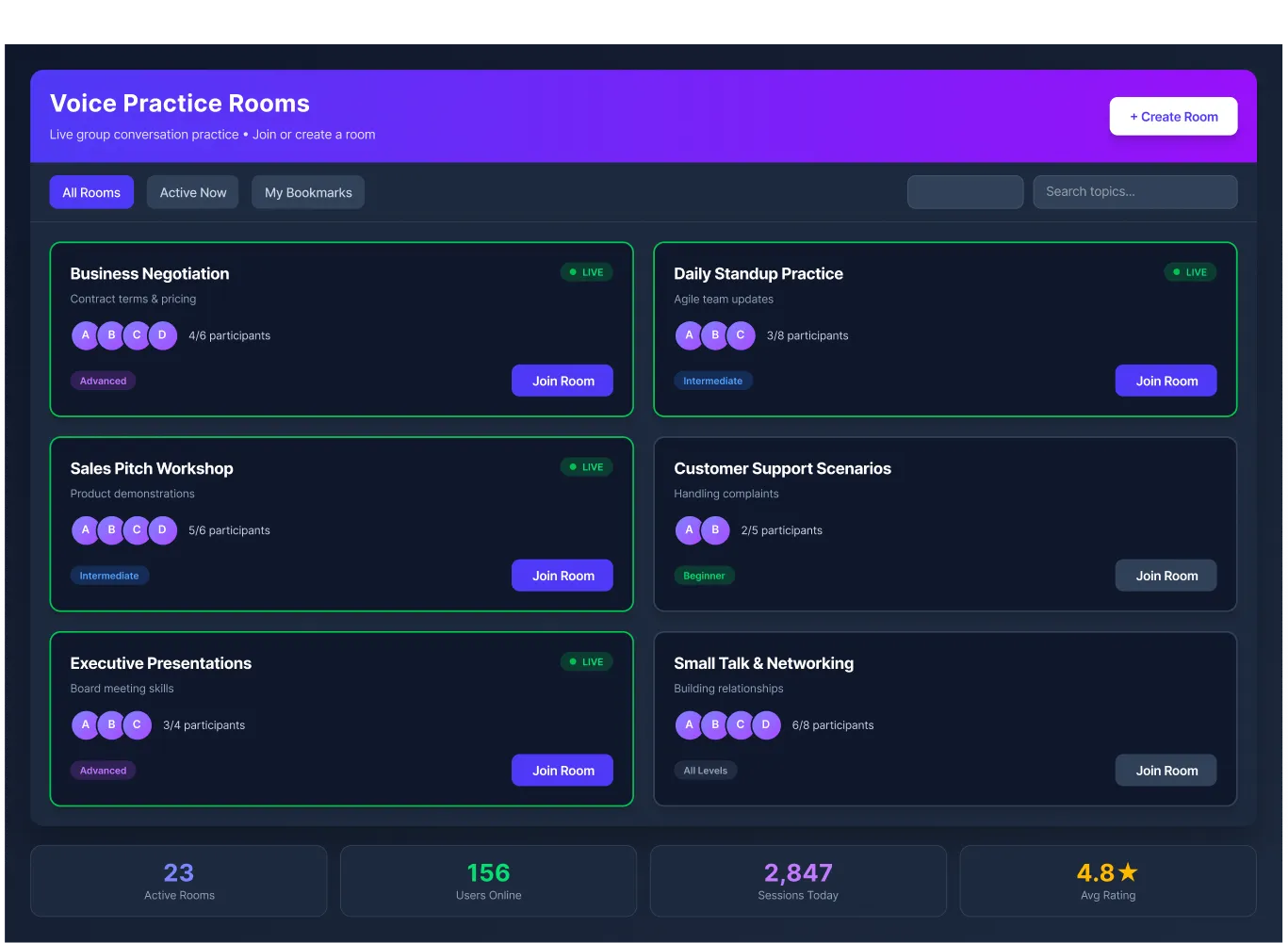
The fix is async-friendly cadence. Daily speaking practice has to be available whenever the employee can do it, and it has to feel low-friction enough that they actually open the app. AI partner practice fills the gaps; voice rooms with other learners across time zones cover the social piece without requiring a single shared meeting time.
Three things make English training for remote teams actually work:
- Async by default. No mandatory synchronous sessions; everything important is replayable or rebookable.
- Cross-zone peer practice. Voice rooms that someone is in regardless of when an employee logs on, so "I don't have anyone to practice with" stops being a real obstacle.
- Manager visibility without micromanagement. Weekly speaking-minute totals visible to the manager, but not minute-by-minute monitoring; remote teams break under surveillance, not under autonomy.
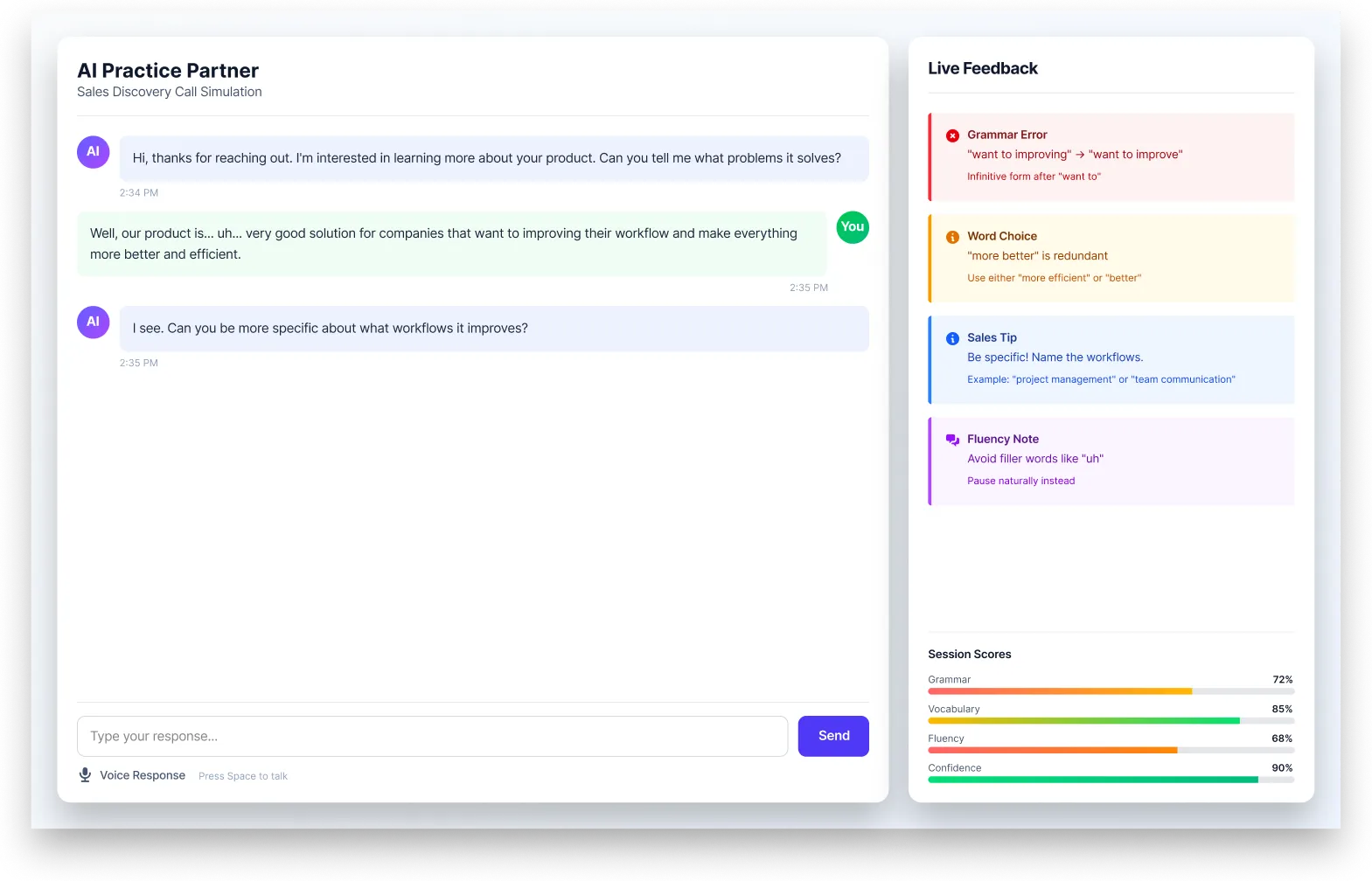
For most distributed companies, this is where AI-led daily practice clearly outperforms class-led programs. The unit of progress is reps, and remote teams need the kind of reps you can't schedule.
English improvement for sales teams
Sales English is its own dialect. The gap is rarely grammar; it's pacing, clarity, and the language of specific call moments — discovery, demo, objection handling, follow-up.
A sales-tuned program targets four scenario types:
- Discovery calls. Asking layered questions in English without sounding like a script. Active-listening phrases ("just to make sure I have this right…") that work under pressure.
- Product demos. Pacing — the most common failure is going too fast and losing the room. Pronouncing product and integration names cleanly. Smooth transitions between screens and value points.
- Objection handling. The phrases that buy time without sounding evasive ("that's a fair concern, let me explain how we think about that"). Reframing in English without translating in their head first.
- Follow-up. Short, clear written English that doesn't sound machine-translated. Subject lines and openers that get opened and replied to.
Generic English programs touch maybe one of these. Effective English improvement for sales teams loops on all four, repeatedly, with specific scenarios. Pair daily AI speaking practice with weekly peer role-plays in voice rooms — a colleague playing the prospect is more pressure than an AI, and pressure is the point.
Language training for customer support teams
Support English is a different beast again. Speed and accuracy together; empathy that doesn't sound canned; written and spoken English at near-equal weight.
What language training for customer support teams has to cover:
- Empathy phrasing. "I completely understand why that's frustrating — let me help fix this" lands very differently than "Apologies for the inconvenience." Both are grammatically correct; only one keeps the customer.
- De-escalation language. Phrases that slow the conversation down without dismissing the customer. The vocabulary of acknowledgement, ownership, and forward movement.
- Accuracy under speed. Refund language, billing language, account-state language — written precisely, even when the agent is handling four tickets simultaneously.
- Common-issue scripts in their own words. Not robotic templates, but the same answer rephrased so it sounds like the agent actually understands. This is the difference between a 4-star and 5-star CSAT response.
- Written + voice parity. Most support roles are now both. The language program has to train both modes — chat clarity is its own skill on top of phone calmness.
Programs that ignore the written side leave half the role untrained. Programs that ignore the empathy and de-escalation language ship technically correct support that still loses customers.
The shared platform — when one tool works for all three
You can usually run sales, support, and remote-team English on a single platform if it has three things:
- Role-tagged scenario library. Discovery calls, support de-escalation, standup updates, and the rest, each as separately-tagged practice content the platform routes to the right role.
- Per-team admin views. A sales manager sees their reps' progress; a support manager sees theirs; nobody is drinking from the company firehose.
- One measurement framework. A single CEFR-aligned speaking assessment used across all three teams, so HR can roll up a single number to leadership even if the practice content is role-specific.
When to split tools: regulated industries with role-specific compliance language (insurance, finance, healthcare) sometimes need a dedicated support training tool alongside a general English platform. For most companies, that's overkill — one platform with role-tagged content does the job and is far easier to administer.
Comparison table — what each team needs
| Team | Cadence | Scenario focus | Skill priority | Manager visibility | Best fit format |
|---|---|---|---|---|---|
| Remote teams | Async, 3×/week | Standups, async written updates, cross-zone meetings | Confidence under pressure, written clarity | Weekly speaking minutes; no surveillance | AI partner + cross-zone voice rooms |
| Sales teams | 3×/week + 1 weekly peer role-play | Discovery, demo, objection handling, follow-up | Pacing and clarity > grammar perfection | Weekly call quality + speaking minutes | AI partner + peer voice rooms with role-play |
| Support teams | Daily 10–15 min + weekly written drills | De-escalation, empathy phrasing, common-issue scripts, written precision | Speed + accuracy + empathy together | CSAT trend + speaking minutes | AI partner + writing-feedback module |
30 / 60 / 90-day rollout cheat sheet for cross-team programs
- Days 1–30 — Place and segment. One placement test for everyone. Tag each employee by team (remote / sales / support). Wire the role-tagged scenario library to those tags. Pilot with one cohort per team.
- Days 31–60 — Per-team cadence. Remote and support: daily short reps. Sales: daily reps + weekly peer role-play. Each manager gets a 5-minute weekly view of their direct reports.
- Days 61–90 — Re-measure with role overlay. Re-run the speaking assessment. Layer one role-specific business signal: call quality for sales, CSAT trend for support, meeting participation for remote engineering and leadership. Compare against day-zero baseline. Decide which cohorts go next.
Frequently asked questions
What's the best English training for remote teams in 2026?
The best English training for remote teams in 2026 is async by default and reps-heavy. Live group classes break under time-zone load — by week three, attendance from non-headquarters regions usually collapses. What works instead is daily AI-partner speaking practice combined with cross-zone voice rooms where someone is always available to practice with. Add a light, manager-visible cadence (weekly speaking-minute totals, not minute-by-minute tracking) and one short monthly check-in tied to a per-employee goal. Distributed teams need autonomy plus accountability — not surveillance, not mandatory live sessions.
How is English improvement for sales teams different from general English training?
General English training teaches the language; English improvement for sales teams teaches the moments — discovery, demo, objection handling, follow-up. The grammar is rarely the problem for B2B sellers; pacing, clarity, and call-specific phrasing are. An effective program loops on those four scenario types repeatedly with realistic pressure: AI practice for daily reps, plus a weekly peer role-play in a voice room where a colleague plays the prospect. Generic English programs ignore call-specific language and leave reps technically correct but commercially weaker than they should be.
What does language training for customer support teams need to cover?
Language training for customer support teams has to cover four things together: empathy phrasing that doesn't sound canned, de-escalation language for hard conversations, accuracy under speed for refund and billing language, and common-issue scripts the agent rephrases in their own words. It also has to train both spoken and written English, because most support roles are now both. The fastest signals that the program is working are CSAT trend on English-language tickets and a measurable drop in repeat-contact rate — both correlate with empathy and clarity, not with grammar perfection.
Can one platform serve sales, support, and remote teams together?
Yes, for most companies, if the platform has a role-tagged scenario library, per-team admin views, and a single shared measurement framework. The economic and administrative case for one platform is strong: shared placement test, shared dashboards, one vendor relationship, one compliance review. The case for splitting only holds for highly regulated industries (insurance, finance, healthcare) where support-specific compliance language genuinely needs a dedicated tool. For everyone else, one platform with role-tagged content is the simpler and more measurable choice.
How often should distributed teams practice English to actually improve?
Three short sessions per week (15–20 minutes of voice-on speaking practice) is the realistic floor for visible improvement. Daily 10-minute reps work even better, particularly for support agents who benefit from constant phrasing exposure. The wrong answer is one long weekly class, which produces low total speaking time and breaks under time-zone load for distributed teams. Put the sessions on the calendar, make them manager-visible, and remove every click between 'open the app' and 'start talking' — that's how you keep 'I freeze when I speak' from staying true a year later.
Related articles
- Best English learning app for working professionals — Individual-skill view of the people on these teams.
- How AI helps you practice real-life English conversations — Backs the role-play and scenario argument central to this guide.
- Improve English speaking — Core outcome shared across all three team types.
- Practice English speaking without a partner — Solves the remote-team "no one to practice with" blocker.
Train every team to speak — together.
One platform, role-tagged practice for sales, support, and remote — daily reps your team actually does, with results you can show leadership in 90 days.
Try Enverson AI Free