If you've been wondering how to learn Russian without spending two years on grammar drills and still freezing the moment a real conversation starts, this guide is for you. Russian has a reputation for being hard — Cyrillic, six cases, perfective vs imperfective verbs — and that reputation pushes a lot of learners into endless studying instead of actual speaking.
The result is a familiar trap: "I understand it but I can't speak." This 2026 plan to learn Russian language is built backwards from that. You'll lock in Cyrillic in week one, build a small but real working vocabulary, and start speaking out loud from day one — with an AI conversation tutor or a partner — instead of waiting until you "feel ready". Here's the step-by-step.
Step 1 — Lock in Cyrillic in your first week
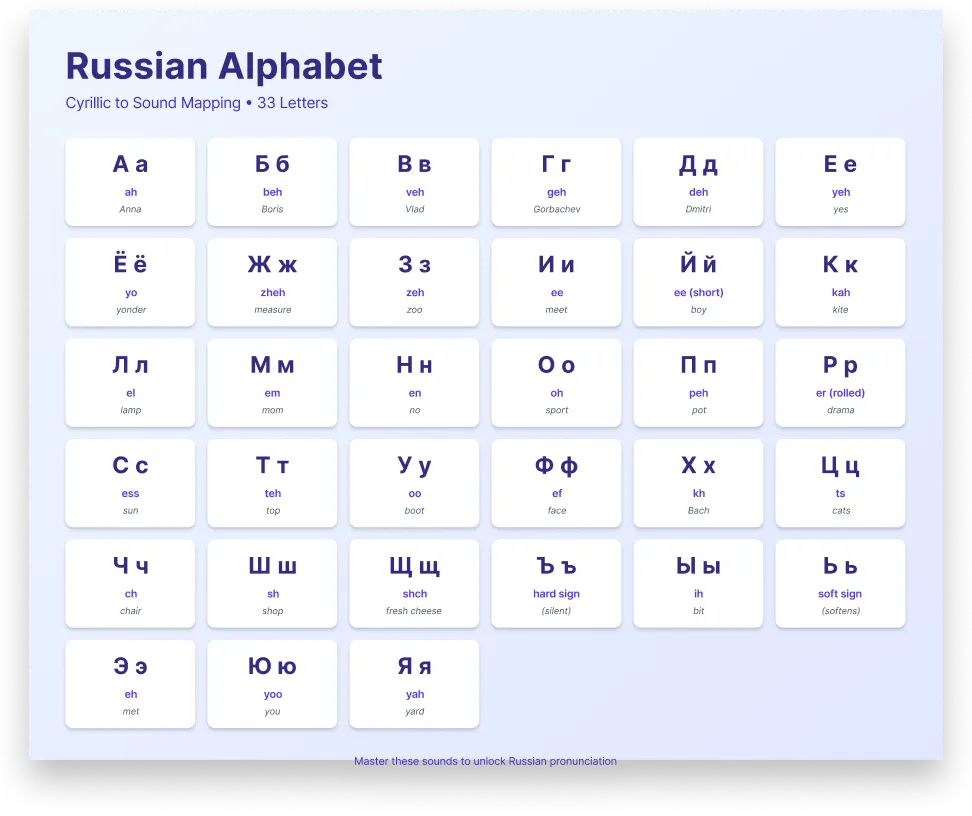
Cyrillic looks intimidating from the outside and turns out to be the easiest part. You only need 33 letters, and roughly a third of them already look and sound like English (А, К, М, Т, О). Another chunk are "false friends" that look familiar but sound different (В = "v", Н = "n", Р = "r", С = "s"). The rest — Ж, Ч, Ш, Щ, Ы, Ю, Я — are genuinely new but follow consistent rules.
Don't waste two months on this. Spend 20 minutes a day for 5–7 days drilling letter sounds with audio, then start reading street-level Russian — café menus, song titles, Instagram captions of Russian-speaking creators. Reading words you don't yet understand is fine — your eyes need to stop translating шишка as "mmka" and start seeing it as "shishka". Once Cyrillic is automatic, every other step gets faster.
Step 2 — Build a 500–1,000 word survival vocabulary
The 1,000 most common Russian words cover roughly 75% of everyday spoken language. That is the leverage point. Don't memorize random vocab lists — pick a frequency-ordered deck (like a 1k or 2k Russian core list) and learn it with spaced repetition.
Aim for 15–25 new words a day for the first month. Don't drill in isolation; learn each word in a short example sentence so you absorb the case it takes and the verbs that go with it. By week 4 you should be able to read short Russian texts with maybe 30% comprehension and start guessing the rest from context. That's the "I can do this" inflection point — keep going.
Step 3 — Start speaking out loud from day one (with an AI tutor)
This is the step almost every Russian self-learner gets wrong. They wait until they "know enough grammar" before speaking. Then a year passes and they still haven't said a full sentence out loud. Don't be that learner.
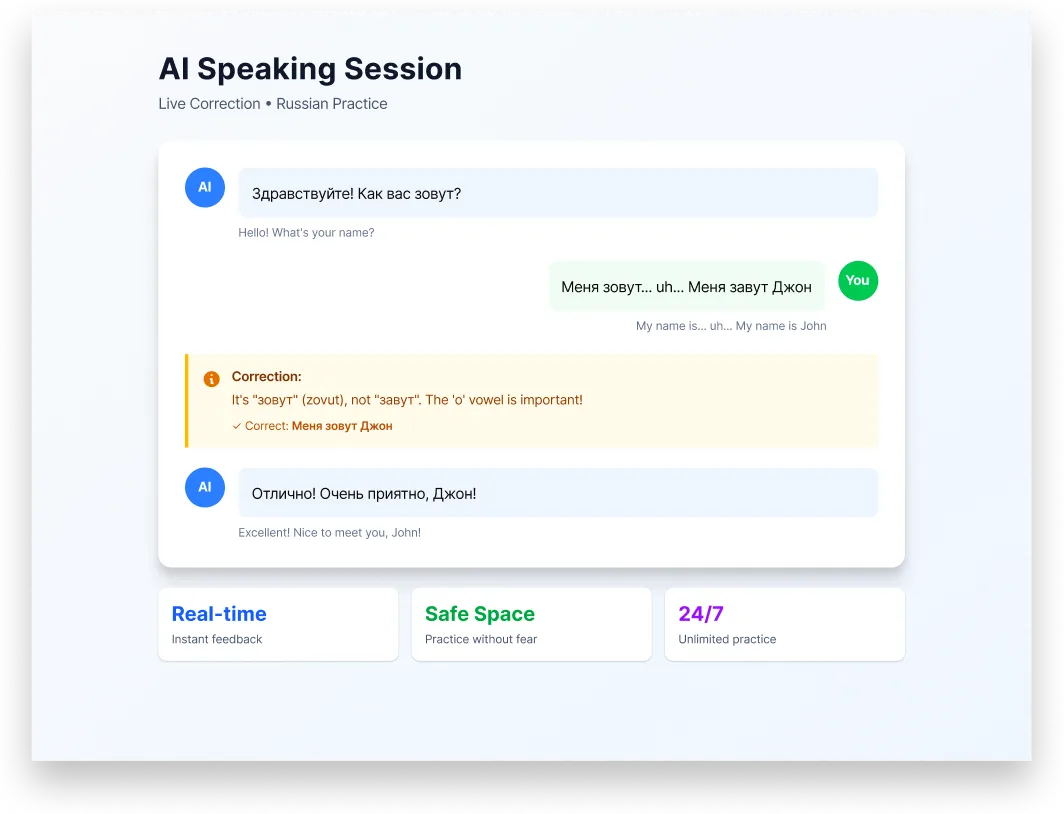
From day one, speak. Read your example sentences aloud. Repeat after native audio. Describe your morning in Russian, even if it's broken — Я пью кофе. Я еду на работу. The point is to build the muscle. If you don't have anyone to practice with — and most beginners don't — use an AI conversation tutor. Enverson AI's AI tutor is built around exactly this gap: low-pressure speaking practice with real-time correction, so you can talk every day, hear yourself, and get fixed without the embarrassment of a live partner. The methodology — speak, get corrected, try again, repeat tomorrow — is what closes the gap between understanding and speaking. It works the same in any language; Russian is no exception.
Step 4 — Get the grammar that matters first (cases, aspect, verbs of motion)
You don't need to "learn Russian grammar" all at once. You need three things, in this order:
- The case system, in the right priority. Nominative, accusative, and prepositional first — they cover the bulk of beginner sentences. Genitive next (it shows up in negation and quantities). Dative and instrumental can wait until month 3. Don't try to memorize all six case tables in week two; you'll burn out.
- Verb aspect (perfective vs imperfective). Almost every Russian verb has a pair — one for the process, one for the result. писать / написать. Get the pattern early, even if you make mistakes for months; it's a long-tail skill.
- Verbs of motion. Russian has a famously specific set of motion verbs (идти/ходить, ехать/ездить, etc.). Beginners hate them. Learn them as fixed pairs in real sentences, not as abstract rules.
Skip everything else for now — participles, gerunds, all the rare cases — until you're holding 5-minute conversations.
Step 5 — Use Russian content you actually enjoy
Once you have ~1,000 words and basic case sense, switch part of your input to real Russian content. The rule: pick something you would consume anyway. If you like football, follow Russian-speaking sports YouTubers. If you cook, watch Russian recipe channels. If you play games, find Russian streamers. Comprehensible input you actually enjoy beats "graded readers" you abandon after week 2.
Use subtitles strategically: Russian audio + Russian subtitles, not English. If you can't follow, slow it to 0.75x and re-watch. The goal is to train your ear to Russian speed — which is fast and full of contractions Russian textbooks don't teach you.
Step 6 — Track progress weekly, not daily
Daily progress in Russian feels invisible. You'll think you're not improving — you are. Track on a weekly cadence instead: how many minutes did you actually speak this week? How many new words did you internalize (not just see)? Could you say a sentence this week that you couldn't say last week? Those are the metrics that matter. Not streaks, not "lessons completed", not XP.
If after 6 weeks you can't hold a 2-minute conversation about your day, the problem is almost always speaking time, not study time. Add 15 minutes of daily output and reassess in two weeks.
The role of an AI conversation tutor in a Russian self-study plan
Self-study fails at one specific point: speaking practice. You can read, drill flashcards, and watch videos solo — but you can't have a conversation alone. That is exactly the gap an AI conversation tutor fills, and why it deserves a slot in your daily plan.
What to look for: real-time speaking response (not chat-based), correction that highlights the specific mistake (case, aspect, word order), and the ability to roleplay scenarios you'll actually face — ordering food, introducing yourself, asking for directions. Enverson AI's AI tutor is designed around speaking-first practice with live correction and structured roleplay, which is the exact stack a Russian self-learner needs to break out of the silent-learner phase. Pair it with one good course and you have everything a beginner needs.
What to do vs what to skip (quick reference)
| Do this | Skip this |
|---|---|
| Drill Cyrillic for 5–7 days, then move on | Spending a month on the alphabet |
| Frequency-ordered vocab (top 1k words) | Random "100 useful words" listicles |
| Speak out loud daily from day one | Waiting until you "know enough" to speak |
| Cases in priority order (Nom → Acc → Prep → Gen) | All six case tables in week two |
| Real Russian content you enjoy | Graded readers you'll quit |
| Weekly progress check-ins | Daily streak anxiety |
Frequently asked questions
How long does it take to learn Russian?
It depends on your hours per week and your goal. The U.S. Foreign Service Institute classifies Russian as a Category III "hard" language and estimates around 1,100 class hours to reach professional working proficiency for English speakers. But conversational comfort — being able to handle daily situations, hold a 5-minute chat, order food, introduce yourself — comes much sooner if you front-load speaking. With 30 minutes of daily AI tutor practice plus a structured course, most learners reach that level in 4–6 months. Fluent professional use takes longer; basic real-life confidence does not.
What is the best way to learn Russian as a beginner?
Lock in Cyrillic in the first week, build a 500–1,000 word survival vocabulary using a frequency-ordered deck, and start speaking out loud every single day — with an AI tutor or a real partner. Don't wait until you "feel ready" to speak. The biggest mistake beginners make is over-studying grammar and under-practicing output. Pair one good course with daily speaking reps and you'll cover what 90% of learners never reach: actually using Russian, not just understanding it.
Can I learn Russian by myself without a teacher?
Yes. The bottleneck in self-study is speaking practice, not access to a teacher. If you pair a structured course (or a single textbook plus its audio) with daily speaking — using an AI conversation tutor like Enverson AI for the bulk of it and a weekly conversation partner if you can find one — you can reach conversational Russian on your own. The learners who fail at self-study are usually the ones who stay silent for months. The ones who succeed start talking from week one, even badly.
How do I learn Russian fast?
Cut your studying time, raise your speaking time. The single biggest accelerator is daily output: 30 minutes of AI conversation practice moves you faster than 2 hours of grammar drills, because you build the retrieval reflex grammar drills don't train. Pick one course and stick to it (course-hopping wastes weeks). Front-load the highest-leverage grammar — the case system in priority order, verb aspect — and ignore the rare stuff. And be honest about hours: 1 hour a day for 6 months beats 4 hours a day for 3 weeks.
Is Russian harder to learn than Spanish?
On average, yes — for English speakers. Spanish shares the Latin alphabet, has simpler case-free grammar, and is rated FSI Category I (~600–750 hours to professional proficiency). Russian is Category III (~1,100 hours) due to Cyrillic, six cases, verb aspect, and verbs of motion. But "harder" doesn't mean "longer" if you focus on speaking. Output practice closes the gap faster than grammar study, regardless of language. If your goal is conversational comfort rather than literary fluency, the difference between Spanish and Russian is smaller than the difference between studying daily and studying weekly.
Related articles
Stop studying. Start speaking Russian.
Daily AI conversation practice closes the gap between understanding Russian and actually speaking it.
Try Enverson AI Free