If you want to know how to learn Spanish fast without faking your way through another six months of grammar drills, here's the honest answer: speed in language learning isn't about the number of hours you study — it's about the number of minutes you actually speak.
Spanish is the easiest major language for English speakers (FSI Category I), but most learners still stall because they study in silence and freeze when a real conversation starts. This guide is a 2026 plan built around the one variable that actually moves the needle: daily speaking practice with an AI tutor — specifically, Enverson AI's AI tutor — paired with a focused vocabulary and grammar order. Follow it and you'll be holding short Spanish conversations in weeks, not years.
The truth about "fast" — what's realistic in 30, 60, 90 days
First, set the bar honestly. We do not promise fluent in 30 days — that promise sells apps and disappoints learners. Here's what's actually achievable:
- 30 days, 30 minutes/day: introduce yourself, order food, ask basic directions, talk about your day in present tense. Survival Spanish.
- 60 days, 30 minutes/day: narrate past events (preterite + imperfect), have 5-minute conversations on familiar topics, understand slow native speakers.
- 90 days, 30 minutes/day: opinions, hypotheticals (subjunctive starting), watch Spanish YouTube with subtitles, hold a real conversation with native speakers without freezing.
The single variable that decides whether you hit these or stall is how many minutes per day you spend producing spoken Spanish, not consuming it. Everything below is built around that.
Step 1 — Sort phonetics in 3 days (Spanish is phonetically regular)
Unlike English, Spanish spells what it sounds. Once you learn the rules, you can pronounce any word you read. Spend 3 focused days on:
- The five vowel sounds (a, e, i, o, u — always pure, never reduced)
- The two trills (single tap r vs rolled rr)
- Soft c/z (sounded as "th" in Spain, "s" in Latin America — pick a region)
- ñ, ll, j, h (silent), v (sounds like b)
After 3 days, you can read Spanish out loud, even if you don't yet understand it. That's the unlock — you stop being scared of saying words wrong, which is what makes most beginners freeze.
Step 2 — Learn the top 1,000 Spanish words first (frequency, not random)
The 1,000 most frequent Spanish words cover roughly 80% of everyday speech. That is your leverage. Don't waste a single hour on themed vocab lists ("at the airport", "at the doctor") until you have the core thousand.
Use a frequency-ordered Spanish core deck with spaced repetition. Aim for 20–30 new words a day for the first 5 weeks. Always learn each word inside a short example sentence so you absorb its real usage — Spanish is full of small verbs (ser/estar, por/para, saber/conocer) where the whole game is which one and when. Isolated flashcards won't teach you that. Sentences will.
Step 3 — Speak from day one with Enverson AI's AI tutor
This is the most important step in the plan, and the one most learners skip. They study Spanish for months, then freeze the first time someone asks "¿Cómo estás?" because they've never said it out loud under pressure.
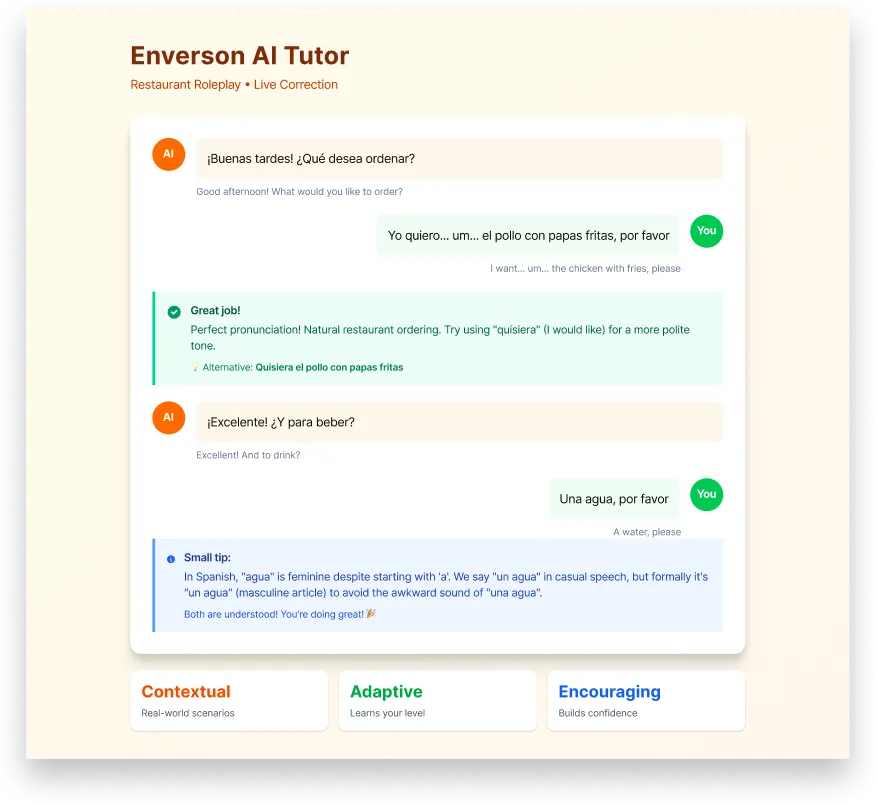
The fix is daily speaking from week one, even when your Spanish is broken. The reason most self-learners can't do this is simple: "I don't have anyone to practice with." Solo apps drill grammar but don't make you talk; tutors are expensive and intimidating; conversation partners are hard to find on a beginner schedule. Enverson AI's AI tutor closes exactly this gap. It's a speaking-first AI conversation tutor that:
- Responds to your voice in real time, not in chat
- Corrects the specific mistake you made (verb conjugation, ser/estar choice, gender agreement, word order) — not a generic "try again"
- Roleplays the scenarios you'll actually face in Spanish: ordering, introducing yourself, asking for help, small talk, work
- Adapts difficulty to your level, so you never plateau on the same easy prompts
The result is the one thing solo learners never get: daily reps in Spanish output, with feedback, in a low-pressure environment. That's the entire mechanism behind learning Spanish fast. There is no faster shortcut, and there is no skipping it.
Step 4 — Grammar in priority order (present → preterite/imperfect → subjunctive last)
Beginners try to learn all Spanish grammar in parallel and burn out. Sequence it instead:
- Weeks 1–3: Present tense + ser/estar. This alone unlocks 70% of basic conversations. Master regular -ar/-er/-ir conjugations, then the irregulars (tener, ir, hacer, decir, ser, estar). Drill ser vs estar until it's automatic.
- Weeks 4–6: Preterite + imperfect (the two past tenses). Spanish has two past tenses where English has one — this is the single hardest beginner concept. Don't avoid it; learn the use difference (completed vs ongoing/habitual) early and let accuracy come with reps.
- Weeks 7–10: Future + conditional + commands. Easy to layer on once present is automatic.
- Weeks 10+: Subjunctive. Yes, the famous "Spanish subjunctive". No, it is not the priority. Native speakers use it in specific triggers; learn it in patterns, not as an abstract mood.
Skip everything outside this list (gerunds, perfect tenses, vosotros if you're learning Latin American Spanish) until you're holding 5-minute conversations.
Step 5 — Switch your input to real Spanish content you enjoy
Once you have ~500 words and present tense, replace 30% of your "study" time with comprehensible Spanish input you actually enjoy. Football, cooking, gaming, comedy, news — pick what you'd watch in English anyway and find the Spanish version.
Subtitle rule: Spanish audio + Spanish subtitles, not English subtitles. If you can't follow, slow it to 0.75x. The goal is to train your ear to native Spanish speed and the contractions that textbooks won't teach you ("voy a" → "voia", "para" → "pa").
Step 6 — Stack a 30-minute daily routine and protect it
Hours-per-week matters less than consistency. A protected 30-minute daily slot beats 3 hours on Saturday. The non-negotiable structure:
- 15 min speaking with the AI tutor (the highest-leverage block — never skip)
- 10 min vocab via spaced repetition (top 1k deck)
- 5 min comprehensible input (a Spanish video, a song with lyrics, or a short article)
Track on a weekly cadence — not daily streaks, not "lessons completed". Ask one question every Sunday: did I speak Spanish out loud at least 5 days this week? If yes, you're learning fast. If no, fix that before changing anything else.
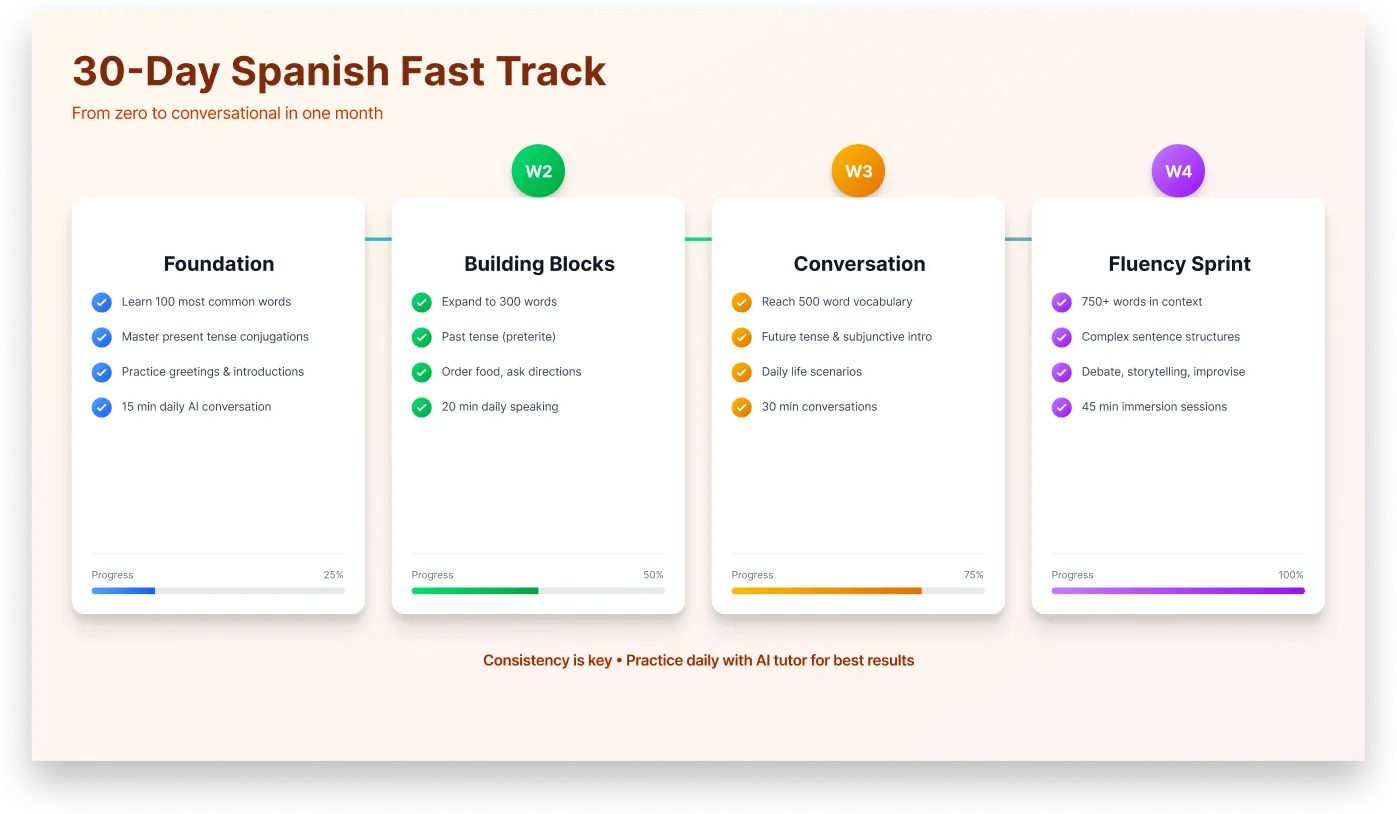
Sample 30-day plan (week by week)
| Week | Speaking (Enverson AI tutor) | Vocab focus | Grammar focus | Input |
|---|---|---|---|---|
| 1 | 10 min/day — alphabet, greetings, basic Q&A | Top 100 words | Present tense regular verbs + ser/estar (intro) | One Spanish song/day |
| 2 | 15 min/day — describe daily routine | Words 100–300 | Present tense irregulars + ser vs estar drills | Slow Spanish news (2 min/day) |
| 3 | 15 min/day — roleplay restaurant, directions | Words 300–600 | Direct/indirect objects + reflexive verbs | Spanish YouTuber (5 min/day) |
| 4 | 20 min/day — short conversations, opinions | Words 600–1000 | Preterite tense (intro) | Spanish series (10 min/day, slow) |
By the end of week 4, you should be able to introduce yourself, talk about your day, order in a restaurant, and survive a basic Spanish conversation without freezing.
Frequently asked questions
How can I learn Spanish fast?
Maximize daily speaking time, not daily study time. The single biggest accelerator is 15–30 minutes of daily output with an AI conversation tutor like Enverson AI — that's the variable that closes the gap between understanding Spanish and speaking it. Pair that with the top 1,000 Spanish words via spaced repetition and a strict grammar order (present → past tenses → subjunctive last). Skip themed vocab lists, skip course-hopping, and protect a 30-minute daily slot. With this stack, conversational Spanish takes weeks, not years.
How long does it take to learn Spanish?
The U.S. Foreign Service Institute classifies Spanish as Category I — the easiest tier for English speakers — and estimates around 600–750 class hours to reach professional working proficiency. Conversational comfort comes much sooner: with 30 minutes of daily AI tutor practice, most learners can hold short conversations in 4–8 weeks and have natural 10-minute conversations in 3–4 months. Hours per week and daily speaking minutes matter far more than total weeks. Daily for 6 months beats sporadic for 2 years.
What is the best way to learn Spanish for beginners?
Start speaking from day one — even when your Spanish is broken — and learn the top 1,000 words by frequency, not by theme. The biggest beginner mistake is over-studying grammar in silence and never producing output. Use Enverson AI's AI tutor for daily speaking practice (15 minutes minimum), a frequency-ordered vocab deck, and a strict grammar priority (present + ser/estar first, past tenses next, subjunctive last). One course, one deck, one tutor. Stop searching for the "perfect" method and run this stack for 30 days.
Can I learn Spanish in 30 days?
You can become conversational in 30 days — not fluent. Realistic 30-day arc with 30 minutes a day: phonetics in week 1, top 500 words plus present tense in weeks 2–3, daily AI conversation by week 4. By day 30 you can introduce yourself, order food, ask directions, and hold a basic chat about your day. Anyone who promises fluent in 30 days is selling, not teaching. But conversational Spanish in 30 days is genuinely achievable if you protect the daily speaking slot.
Is Spanish hard to learn?
No — for English speakers, Spanish is the easiest major language to learn. The Foreign Service Institute rates it Category I, the same tier as French and Italian, with about 600–750 hours to professional proficiency. Spanish shares the Latin alphabet, has phonetic spelling, and overlaps heavily with English in vocabulary (cognates). The hard part isn't the language itself; it's daily speaking discipline. Learners who plateau aren't beaten by Spanish grammar — they're beaten by silence. Talk every day and Spanish reveals itself as the fast-track language it actually is.
Related articles
Learn Spanish fast. Start speaking today.
Daily speaking practice with Enverson AI's AI tutor is the variable that turns 30 days into real Spanish.
Try Enverson AI Free