"When I saw the examiner I became stuck, trembled and didn't know what to say." That sentence, in some form, is the most common confession on IELTS forums right now. Test-takers describe the same moment differently – "my mind goes blank," "I forget everything even the simple words" – but the fear is one fear: speaking under pressure with a stranger, in English, with a band score on the line. If you've felt it, the fix isn't more vocabulary. It's a different kind of practice. This guide shows you how to practice english speaking for ielts the way that actually moves your band – solo, daily, and without a tutor.
Most existing IELTS speaking guides give you 5 disconnected tips and end with "but you really need a partner." This one doesn't. You'll get a complete 5-step method you can run alone with an AI examiner, plus the part every other guide skips: how to get real conversation practice on demand, with no tutor fees and no scheduling. IELTS speaking practice alone stops being a compromise once you have the right tools – and in 2026, you do.
The 5-step method (TL;DR)
- Step 1 – Run a daily 20-minute AI examiner drill. Simulate Part 1, 2, and 3 with calibrated band feedback. Not generic ChatGPT – calibrated to the IELTS rubric.
- Step 2 – Record, listen back, find your three repeating errors. Every learner has 3–5 patterns that cap their band. Find yours and target them weekly.
- Step 3 – Join a voice room twice a week for Part 3 with peers. The partner gap, solved. Real conversation, low pressure, on demand.
- Step 4 – Shadow native speakers for 10 minutes a day. The fastest fluency drill ever documented. Pace, intonation, connected speech.
- Step 5 – Run a full mock test once a week and score it. Calibrate against the band descriptors. Track your delta week to week.
Why most IELTS speaking practice fails
Most IELTS speaking guides repeat the same 5–7 tips and then admit, at the very end, "you'll need a study partner – a teacher or a friend." That admission breaks the implicit promise of the guide. Here's why ielts speaking practice alone fails when you only follow the standard advice:
- You can't catch your own errors. As one widely-cited IELTS coach puts it: "Unless you have a very high level of English, it is unlikely that you will be able to recognise your own grammar and lexis errors."
- Generic ChatGPT band scores aren't calibrated. Every guide that recommends ChatGPT-as-examiner also warns its scores aren't completely reliable. You need a system that actually maps to the band descriptors.
- No partner means no Part 3 practice. Part 3 is a discussion. You can't simulate it solo. Facebook groups and Skype-with-strangers are the answers most guides give – they're slow, awkward, and unsafe.
- Anxiety isn't trained out by drills. "My mind goes blank" on test day isn't a vocabulary problem; it's an exposure problem. Without low-stakes speaking reps, the test is your first time speaking under pressure.
The 5 steps below solve all four.
Step 1 – Run a daily 20-minute AI IELTS speaking examiner drill
The 2026 baseline IELTS prep behaviour is already AI-driven – every IELTS forum has the same recurring prompt: "Please act as an IELTS Speaking examiner. Ask me 5 questions from IELTS Speaking Part 1 about my hometown." It works for warm-up. It doesn't work for band calibration.
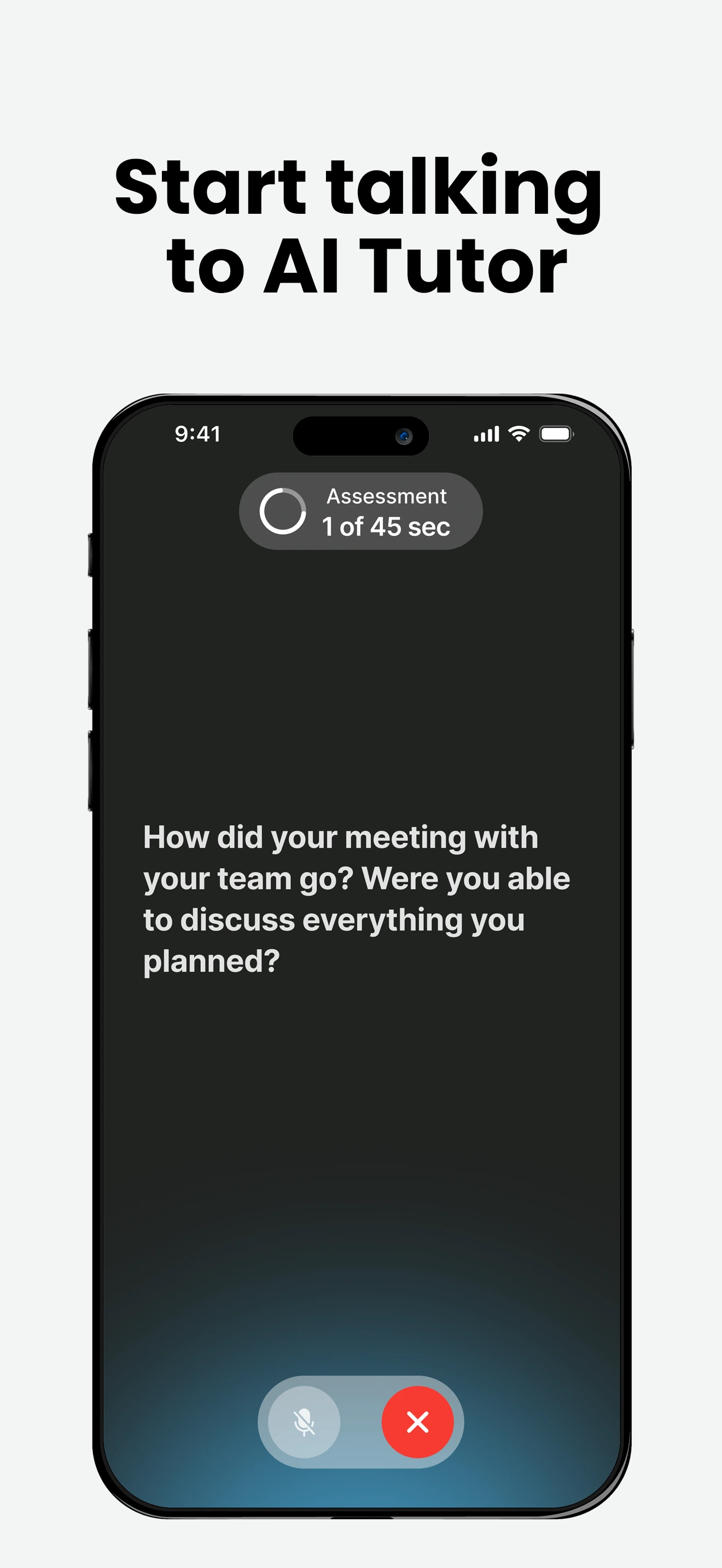
The upgrade is an AI tutor that's calibrated to the IELTS rubric specifically – fluency, lexical resource, grammatical range and accuracy, pronunciation – and gives you band-level feedback after each answer, not vibes.
A 20-minute daily drill that covers Part 1, Part 2, and Part 3
Enverson AI's IELTS mode runs a calibrated examiner simulation – Part 1 questions about familiar topics, a Part 2 cue card with the official 1-minute prep + 2-minute talk timing, and Part 3 follow-up discussion. Feedback maps directly to the four band descriptors so you know which one is holding you back this week.
Step 2 – Record, listen back, find your three repeating errors
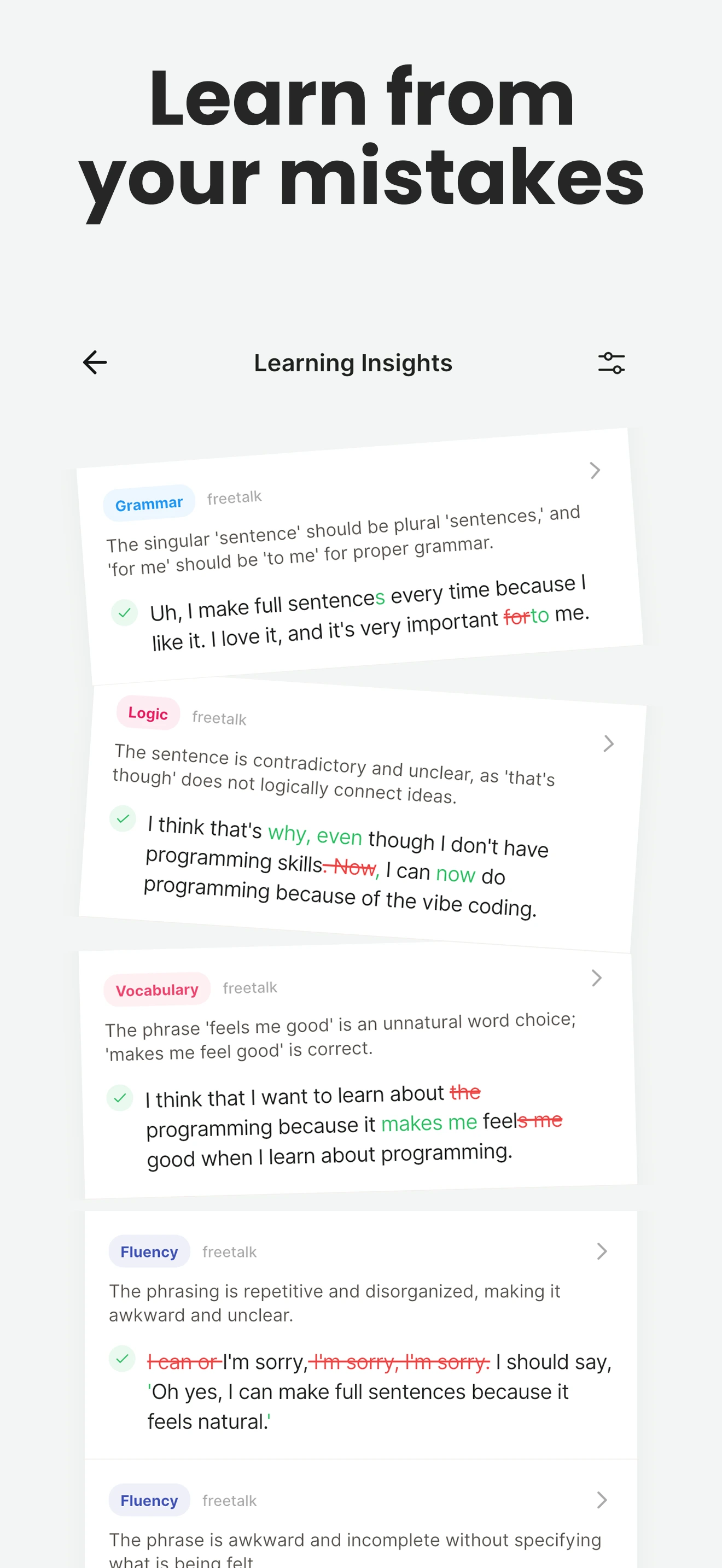
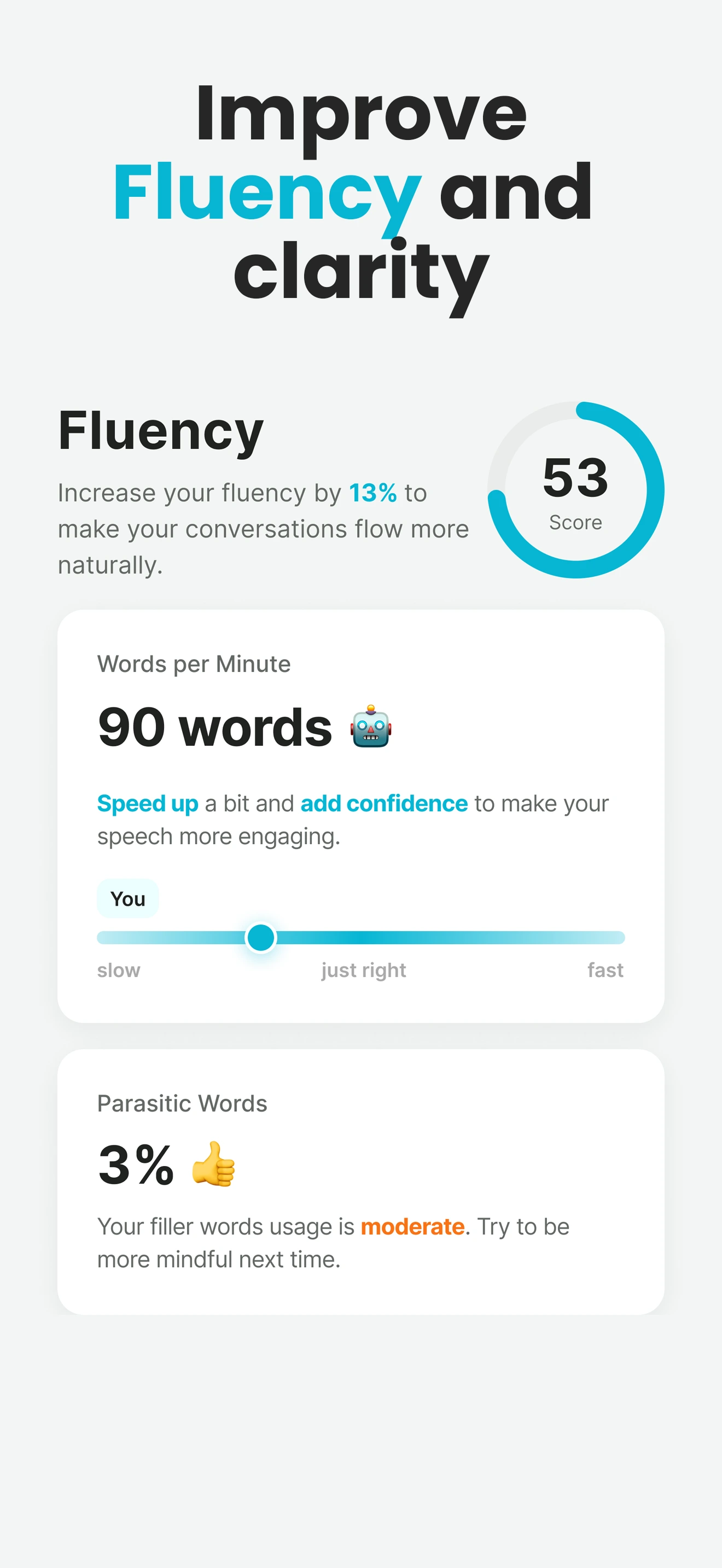
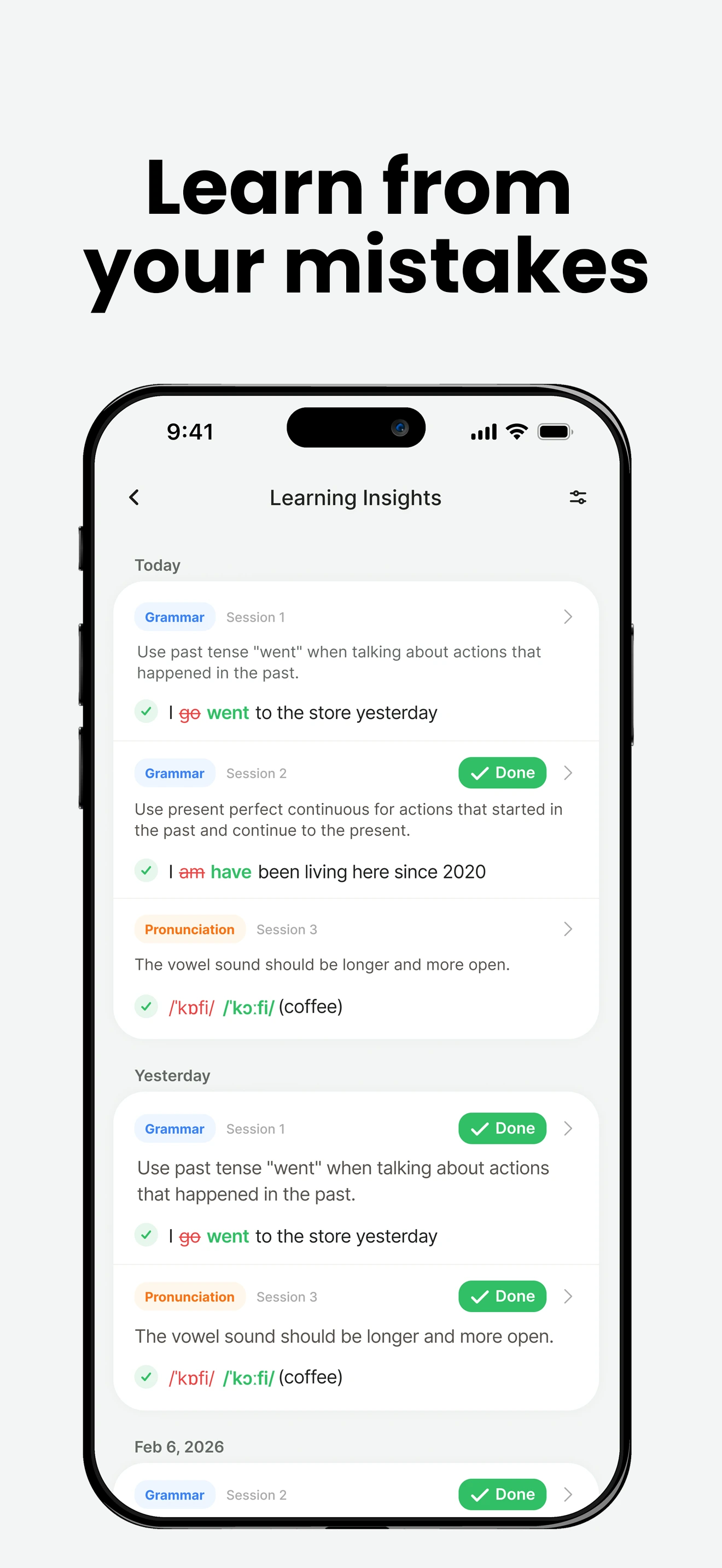
The "record yourself" advice is in every guide for a reason: it works. "Record and play back your talks to assess your fluency, and it will very quickly begin to improve." But most learners record without a target. The upgrade: every learner has 3–5 patterns that are capping their band – overusing "like" or "basically," skipping past tense, defaulting to short answers, mispronouncing the same vowel.
Find the 3 patterns capping your band – and drill them weekly
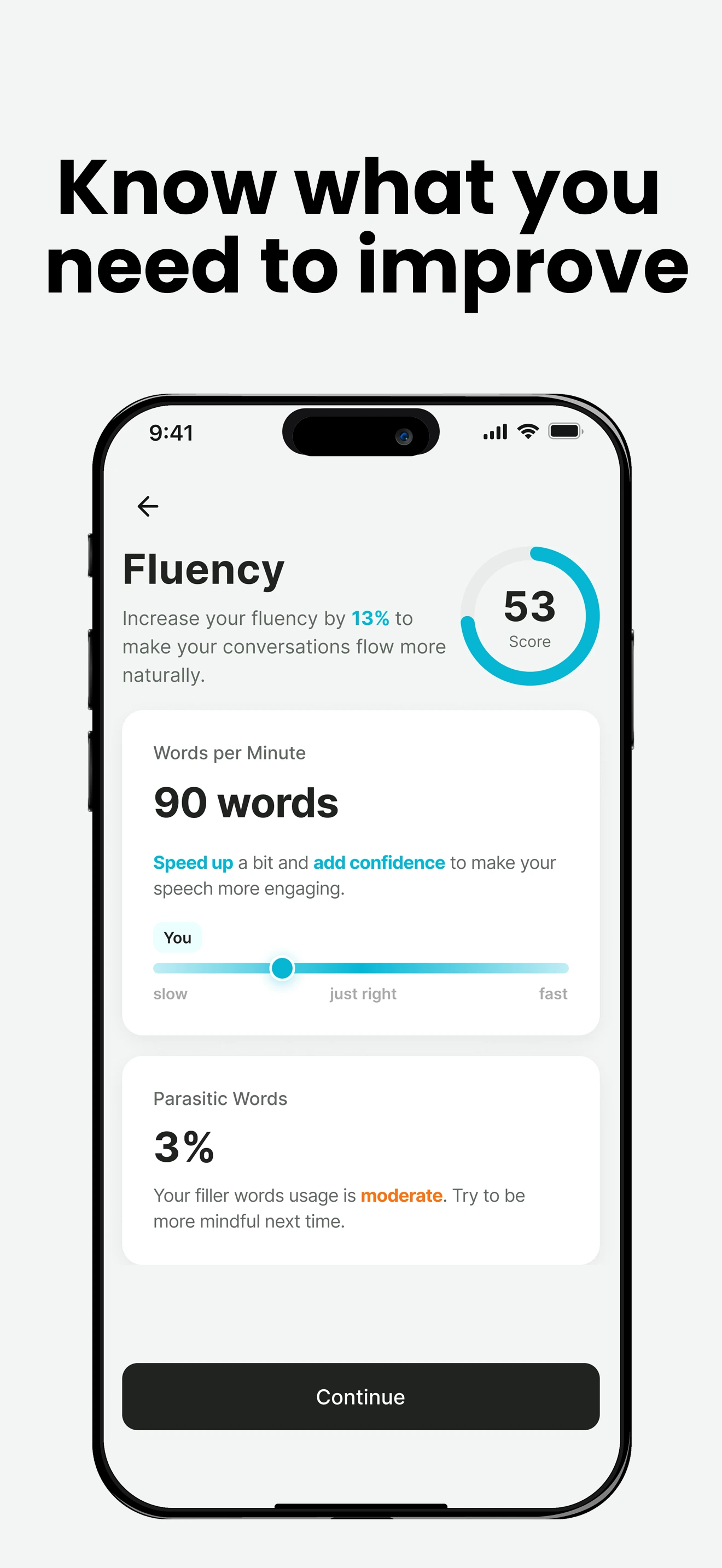
Enverson AI's progress dashboard tracks your filler words, repeated phrases, weak transitions, and grammar slips across every session. By the end of week one you'll have a shortlist of 3 patterns. Drill each one for 5 minutes a day until it's gone.
Step 3 – Join a voice room twice a week for IELTS Part 3 practice with peers
Part 3 is a discussion. The examiner asks abstract follow-up questions and you have to defend a view, compare options, and connect ideas under pressure. Solo AI practice is good for Parts 1 and 2 – it can't fully simulate Part 3 because there's no real interlocutor pushing back.
The standard advice for finding a partner is some version of "check Facebook groups, try italki, post on Reddit." None of that is on-demand, none of it is safe (you're sharing personal info with strangers), and none of it is free.
Real Part 3 practice with other learners, in 1 click
Enverson AI's voice rooms open every day at every level – including IELTS-prep rooms targeted at Part 3 discussion. You join in 1 click, talk for as long as you want, and log off when you're done. No tutor fees. No scheduling. Just real conversation with people who, like you, are tired of practicing alone.
Step 4 – Shadow native speakers for 10 minutes a day
Shadowing – listening to a native speaker and repeating their speech in real time, matching their pace, intonation, and rhythm – is "one of the most powerful spoken English fluency practice techniques ever documented." It trains the muscles of your mouth and the timing of your delivery in a way solo monologue practice never will.
A curriculum of native-speaker clips at your level – built into the daily plan
Enverson AI's structured curriculum includes a daily 10-minute shadowing drill at your current band level – clips chosen for the IELTS register (not casual TikTok English). The app records you shadowing and shows you where your timing or stress drifts.
Step 5 – Run a full mock test once a week and score it against the band descriptors
A drill is not a test. Once a week, run a complete IELTS speaking mock – 11 to 14 minutes, all three parts, no pausing, no restarts. Then score it against the official band descriptors: fluency and coherence, lexical resource, grammatical range and accuracy, pronunciation.
Weekly mock results with a band estimate you can trust
Enverson AI's weekly mock returns a band estimate for each of the four descriptors and a single overall band – calibrated against IELTS scoring, not generic chatbot vibes. Track the delta week over week. If the band isn't moving in 2 weeks, revisit Step 2 and re-target your three patterns.
6-week plan: how to improve IELTS speaking band 7 (and beyond)
This is the plan we recommend if you have a band 6.0–6.5 baseline and a target of 7.0+ in 6 weeks. Adjust by 2 weeks in either direction depending on your gap.
| Week | Daily | Twice this week | Once this week |
|---|---|---|---|
| 1 | 20-min AI examiner drill (Step 1) | Voice room — IELTS Part 3 (Step 3) | Mock test + score (Step 5) |
| 2 | 20-min AI drill + 10-min shadowing | Voice room | Mock test |
| 3 | 20-min AI drill + 10-min shadowing + 5-min targeted error drill (Step 2) | Voice room | Mock test |
| 4 | Same as week 3 | Voice room — focus on follow-up depth in Part 3 | Mock test |
| 5 | Same — push to harder topics in AI drill | Voice room | Mock test under timed conditions |
| 6 | Light drills only — protect rest | One light voice room | Final full mock — taper before exam |
If by week 4 your mock band hasn't moved at least 0.5, your three patterns from Step 2 are wrong. Re-listen to your week-1 recording and re-pick them.
Common mistakes to avoid
- Don't memorise answers. Examiners are trained to spot scripted responses – you'll sound like a "monotonous robot reading off of a script."
- Don't force idioms. "Idiomatic" doesn't just mean idioms; it means natural language use. Use what fits the topic – not a pre-loaded list.
- Don't use vocabulary you don't fully understand. Big words used incorrectly cost more band points than small words used precisely.
- Don't trust ChatGPT band scores as final. Use generic AI for warm-up; use a calibrated tool for band feedback.
- Don't give one-word answers in Part 1. Always extend with a reason or example. The examiner hates this.
- Don't share personal info with strangers in free partner-finder groups. Use a platform that's actually built for this.
Frequently asked questions
How can I practice IELTS speaking alone?
Run a daily 20-minute AI examiner drill that covers all three parts, record yourself, and identify three repeating errors to target weekly. Add 10 minutes of shadowing native speakers and one full mock test per week. The method works alone — but pair it with twice-weekly peer voice rooms for Part 3 discussion practice that solo AI can't fully simulate.
How do I practice IELTS speaking without a partner?
Use an AI examiner for daily drills (Parts 1, 2, and 3) and join on-demand peer voice rooms for the discussion-style Part 3. Enverson AI gives you both in one app — no tutor fees, no Facebook-group scheduling, no sharing personal details with strangers.
How can I use ChatGPT to practice IELTS speaking?
Generic ChatGPT works as a warm-up examiner — paste a prompt like "act as an IELTS Speaking examiner and ask me 5 Part 1 questions about my hometown." But every IELTS guide warns ChatGPT's band scores aren't calibrated to the official rubric. For real band feedback, use a tool calibrated to the four band descriptors: fluency, lexical resource, grammar, pronunciation.
How do I deal with my mind going blank in the IELTS speaking test?
The blank isn't a vocabulary problem — it's an exposure problem. Most test-takers go blank because the test is the first time they've spoken English under pressure. Daily AI examiner drills plus twice-weekly peer voice rooms desensitise the response, so test day feels like another rep, not a first.
How long does it take to improve IELTS speaking from band 6 to band 7?
Most band-6 learners can reach band 7 in 6–8 weeks with consistent daily practice (20-minute AI examiner drill plus 10-minute shadowing), twice-weekly peer voice rooms, and weekly mock tests. If your weekly mock band isn't moving by week 4, your targeted-error patterns are wrong — re-pick them from a fresh recording.
What's the best free way to practice IELTS speaking in 2026?
The free baseline is ChatGPT as an examiner simulator (use the recurring "act as an IELTS Speaking examiner" prompt) plus recording yourself and listening back. The big gap that no free option solves: real Part 3 discussion practice with another person on demand — that's where a paid app with peer voice rooms earns its cost.
Can I get IELTS band 7+ speaking score without a tutor?
Yes — most band-7+ scorers prepare without a private tutor. The non-negotiables are daily speaking practice (not reading or listening), some form of feedback loop you trust, and real conversation reps under mild pressure. An AI examiner combined with peer voice rooms delivers all three for a fraction of tutor cost.
Stop hoping for a speaking partner. Start drilling.
If you're 6 weeks from your IELTS test and tired of practicing alone, Enverson AI is built for exactly this – a calibrated AI examiner for daily drills, peer voice rooms for Part 3, structured curriculum for shadowing, and weekly mock scores that map to the real band descriptors. Get into a real IELTS speaking conversation in 1 click.
Try Enverson AI Free