The hardest part of learning a new language with an AI language learning app is not the language. It is step one. There are dozens of apps, every one of them promises fluency, and none of them tells you plainly what to do on the first evening. So most people default to the safest-looking option – vocabulary drills – and spend three months building a word list they have never said out loud to anybody. This guide answers the only question that matters at the start: where to start learning a language with AI. Short version – take a level test, set one dated goal, and get into a real spoken conversation on day one. Below is the full eight-step path, a day-by-day first week, and a proper tour of what Enverson AI actually does.
The real beginner problem: you are not stuck, you are unstarted
Ask ten people why they gave up on a language and you will hear ten versions of the same story. They downloaded something, did well for a fortnight, felt the sessions getting repetitive, and quietly stopped. Almost none of them say "I could not learn it". What they describe is a sequencing failure: they never got to the part where the language does anything for them.
That happens because the obvious first move is the wrong one. Vocabulary feels like the foundation, so beginners start there – a few hundred words, then a few hundred more, all reviewed silently on a screen. Months later they can recognise a great deal and produce almost nothing. Recognition and production are different skills, and only one of them is what you meant by "learning the language". Someone who can read a menu but freezes when the waiter speaks has not learned less vocabulary than they think; they have simply never practised the thing they are now being asked to do.
There is a second, quieter problem. Traditional study gives you no feedback loop worth the name. You do an exercise, you get a tick or a cross, and nothing about the next exercise changes. You could repeat the same mistake for a year without anyone noticing, and eventually the mistake becomes a habit you have to unlearn twice over. An AI language learning app is worth using precisely because it can close that loop – if you set it up correctly from the start.
The single most important principle: speak on day one
If you take one thing from this guide, take this: start speaking on day one, not when you "feel ready". The feeling of readiness is not a stage you pass through. It is a by-product of having already spoken a lot, which means waiting for it guarantees you wait indefinitely.
The reasoning is straightforward. Speaking is its own skill, made of things you cannot get from reading: retrieving a word fast enough to use it, assembling a sentence while the clock runs, hearing yourself and adjusting, and tolerating the discomfort of being imperfect in real time. None of that is trained by silent review. You can know a rule perfectly and still be unable to apply it at conversational speed, because applying it at speed is a separate ability that only develops through repetition under mild pressure.
There is also a motivational argument. Speaking produces evidence. The first time you hold thirty seconds of unbroken conversation, you have proof that this is going somewhere, and that proof is what carries you through the flat weeks later on. Flashcards produce no such evidence – only a number that goes up.
The reasonable objection is that beginners cannot speak, because they have nothing to say yet. This used to be true when the only options were a human tutor you had to pay for and be embarrassed in front of. It is much less true now. An AI tutor will scale down to single words, wait as long as you need, correct without any social cost, and repeat itself indefinitely. A beginner's first conversation might be twenty words long, half of them wrong. That is a perfectly good first conversation, and it is worth more than a thousand flashcards.
Start here: the 8-step beginner path
This is the order to do things in. Steps one to four should all happen on your first day – together they take well under an hour. Steps five to eight unfold across the first month.
1. Take a level placement test and learn your CEFR level
Do this before you do anything else. Without a level, an app is guessing at your difficulty, and guessed difficulty is either boring or demoralising. A short placement test maps your speaking, listening, grammar and vocabulary onto the CEFR scale – A1 and A2 for beginners, B1 and B2 for independent users, C1 and C2 for advanced ones – and everything downstream calibrates from that number. If you want to understand what the levels actually mean before you sit one, our guide to testing your English level walks through each band, and our note on how Enverson AI aligns with IELTS, TOEFL and CEFR standards explains how the estimate maps onto the exams you may care about later.
2. Set a concrete goal and a deadline
"I want to be fluent" is not a goal; it is a mood. Replace it with something that has an outcome and a date. Pass a job interview in English by November. Hold a ten-minute conversation with a colleague without switching languages. Reach B2 within a year. Handle a week abroad without a translation app. The goal is not motivational decoration – it decides which scenarios you rehearse, which vocabulary matters, and how you will know whether the last month worked. If you want a realistic sense of what timeline to attach, we have written separately on how long it actually takes to move between levels.
3. Commit to a daily active-speaking block of 30–60 minutes
Put a block in your calendar, at a time you can genuinely defend, and treat it as speaking time rather than app time. The distinction matters more than the duration. Thirty minutes with your mouth moving beats two hours of scrolling through review screens, because only one of those is practising the skill. Consistency beats volume here: five sessions of forty minutes across a week will do more than one marathon Sunday, since the language needs repeated contact to settle rather than a single heavy exposure.
4. Have your first AI conversation immediately
Same day. Not after the tutorial, not after the first vocabulary set. Open a conversation and speak. It will feel awkward for roughly four minutes and then it will simply feel like a conversation. Getting this over with on day one is the single highest-leverage thing a beginner can do, because it removes the psychological barrier permanently rather than letting it grow for a month.
5. Let real-time correction do the teaching
Do not go away and study grammar before speaking again. Speak, get corrected in the moment, understand why, repeat the corrected version aloud, and continue. This inverts the traditional order – you meet the rule at the moment you needed it and failed, which is when it is most likely to stick. We go deeper into the mechanics in our piece on the AI English learning app that corrects your mistakes as you speak.
6. Add role-play scenarios tied to your actual goal
By the end of week one, free conversation should feel survivable. Now aim it. Pick scenarios from the library that match your goal directly: if the goal is a job interview, rehearse the interview; if it is a trip, rehearse hotel check-in and ordering food. Rehearsed situations are the ones you do not freeze in.
7. Move into live voice rooms with other learners
Around week two or three, add real people. An AI tutor is patient, clear and endlessly accommodating, which is exactly what a beginner needs and exactly what the real world is not. Live voice rooms reintroduce the unpredictability – other accents, other paces, other people also searching for a word – in a setting where everyone is at your level and nobody is judging.
8. Review the dashboard weekly and adjust
Once a week, ten minutes, look at the numbers. Not the streak – the per-skill breakdown. Whichever line is flattest is your instruction for next week. This is the step almost everyone skips, and it is the one that stops a plateau becoming permanent.
What Enverson AI actually does – a feature-by-feature tour
The steps above are generic advice. Here is the specific machinery that carries them out, so you know what you are looking at when you open the app for the first time.
The agentic AI tutor – a conversation in 1 click
The core of Enverson AI is a spoken conversation you can enter in one click, with no setup ritual in the way. The tutor is agentic rather than a chat wrapper: it chooses topics, steers toward structures you have not yet mastered, holds the thread when you go quiet, and decides what to do next based on what you have done before. For a beginner that means you never face a blank screen wondering what to say — the tutor opens, and you answer.
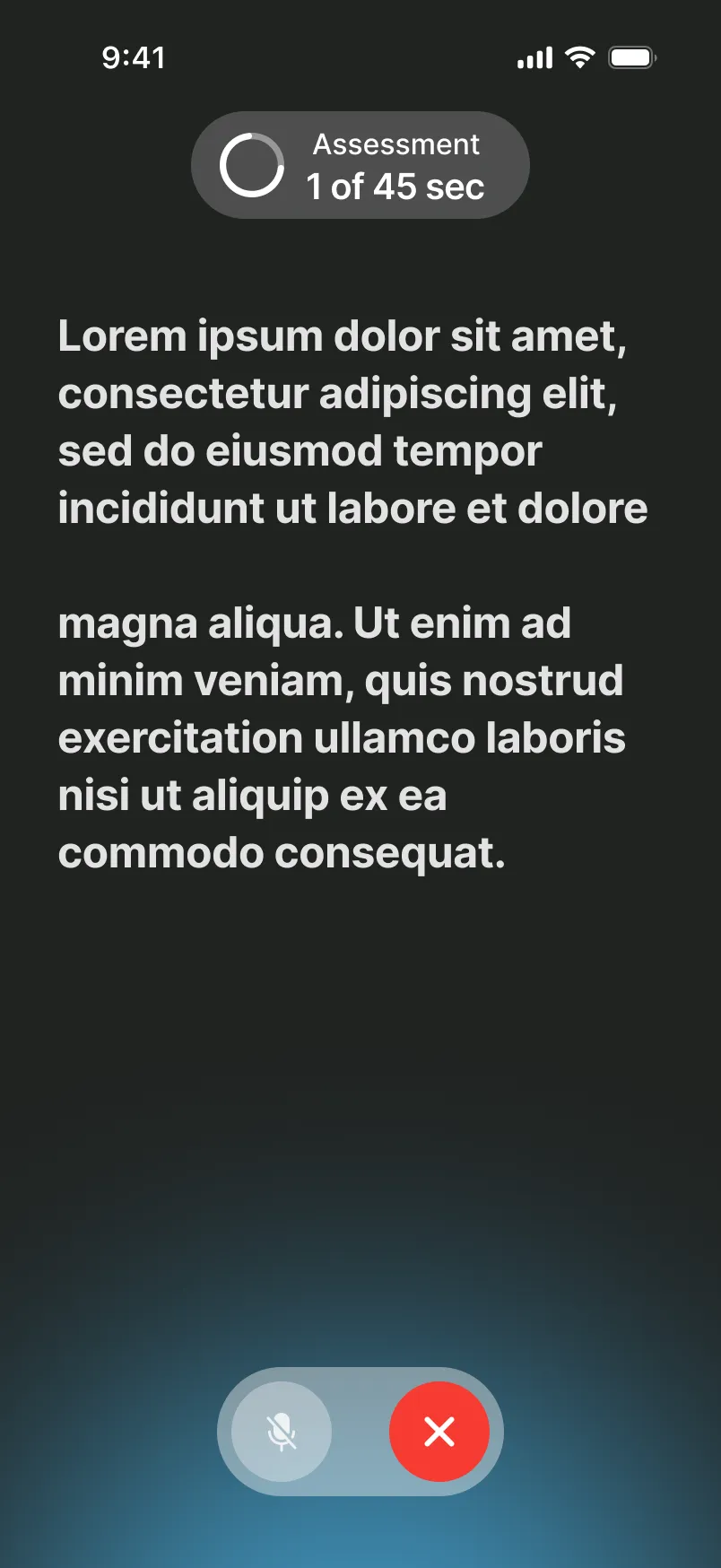
Real-time correction of grammar, vocabulary and pronunciation
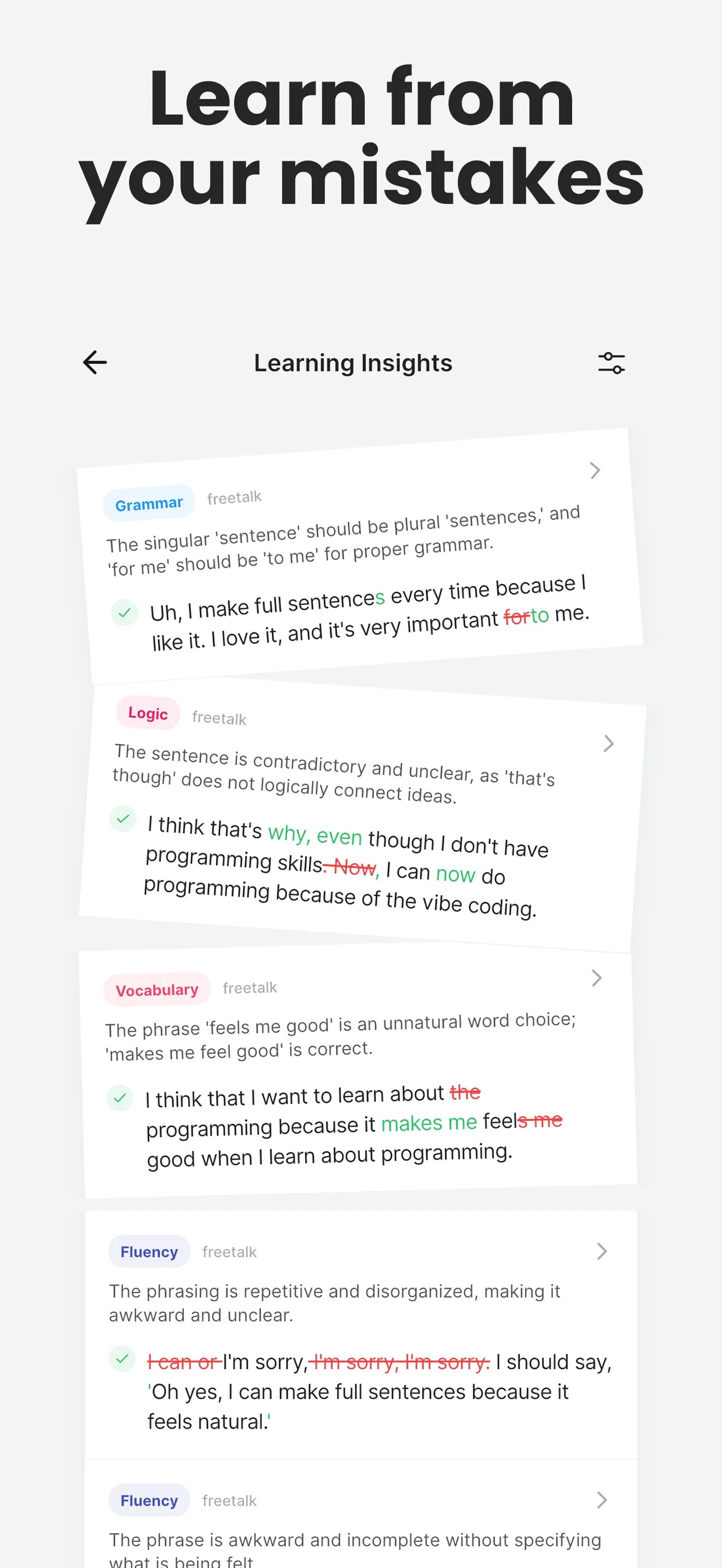
Mistakes surface the second they happen, across all three layers: the grammar you got wrong, the word that was not quite the right one, and the sound that did not land. Each correction comes with a short "why" — one line, not a lecture — and the correct version to repeat back before the conversation continues. Repeating it aloud is the part that matters; reading a correction teaches you very little, saying it teaches your mouth.
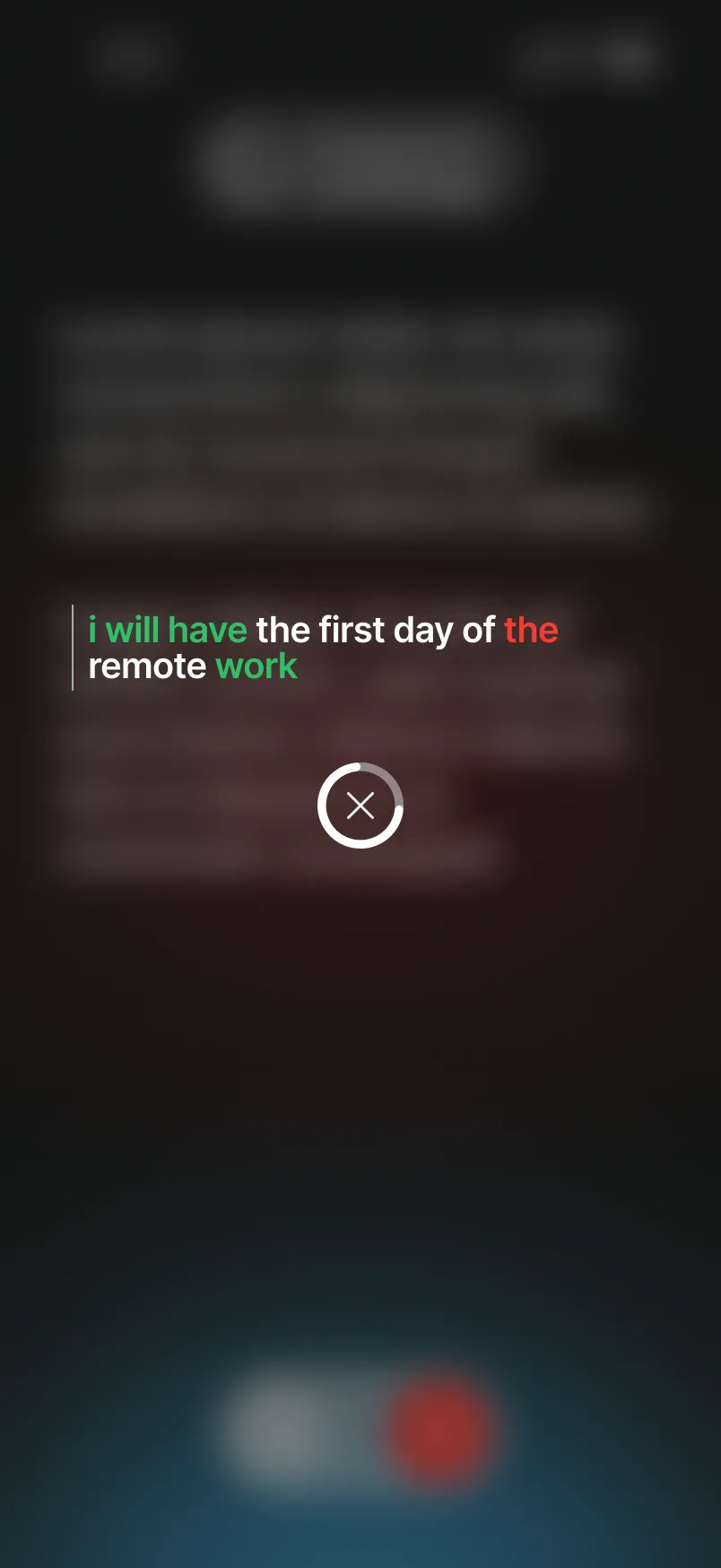
What separates this from a chatbot that happens to correct you is what happens afterwards. Enverson AI keeps a long-term memory of your past mistakes, so an error you made in week one does not disappear once the session ends. It is re-drilled quietly in later lessons — the tutor steers the conversation back toward the structure until you produce it correctly without prompting. You will notice, weeks in, that a topic keeps reappearing; that is not coincidence, it is the thing you kept getting wrong.
Sitting above all of it is the Multidimensional Personalization Engine. It adapts on more than one axis at once: your level, so difficulty tracks just above your current ability; your learning style, so the balance of correction, explanation and free talk suits how you actually absorb things; and your tone, so a session adjusts when you sound hesitant or frustrated rather than ploughing on regardless. It is the reason the app on day sixty does not behave like the app on day one — we cover the mechanics of that daily adaptation in more detail in our piece on the English app that adapts to your level daily.
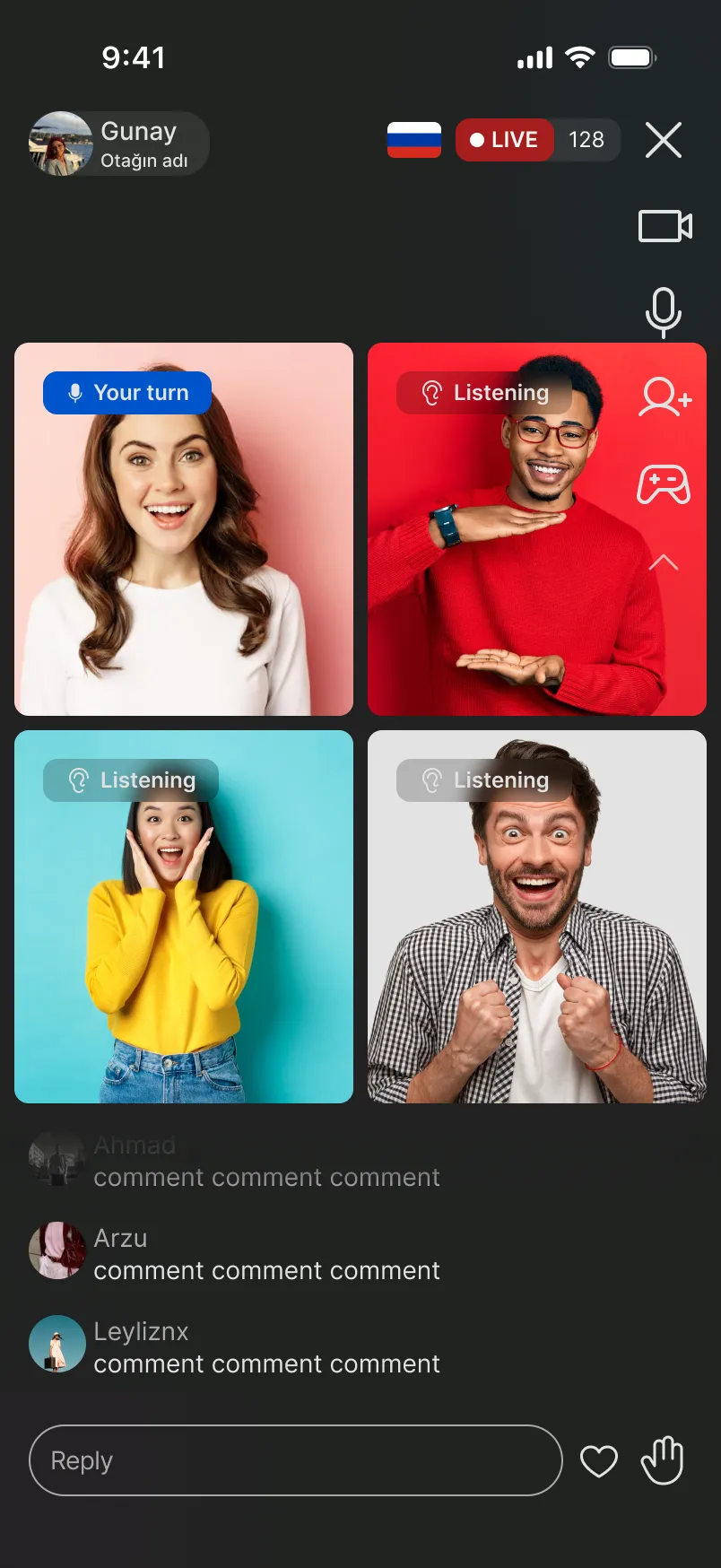
Live voice rooms with other learners (the Combo feature)
Combo is the live-matching feature, and it is the step most AI apps have no answer for. It pairs you with other learners at your exact level for AI-moderated group practice: you speak with real humans, the AI keeps the conversation moving when it stalls, and because everybody in the room is at the same level, nobody switches to a shared language out of politeness. This is where an app stops being practice and starts being usage.
The real-world role-play scenario library
Job interview. Ordering food. Hotel check-in. Salary negotiation. Doctor's visit. The scenario library covers the situations learners actually freeze in, and the AI plays the other side properly — the interviewer asks a follow-up you did not prepare for, the receptionist mentions a problem with your booking. You run the scenario until it stops feeling like a script and starts feeling like something you have already survived once.
The personalized fluency dashboard
The dashboard tracks fluency over time, vocabulary growth, grammar accuracy, pronunciation and speaking speed — broken out per skill rather than rolled into one meaningless score. It is deliberately not a streak counter. A streak tells you that you opened an app; this tells you whether your speaking speed has moved in three weeks, which is the question you actually wanted answered.
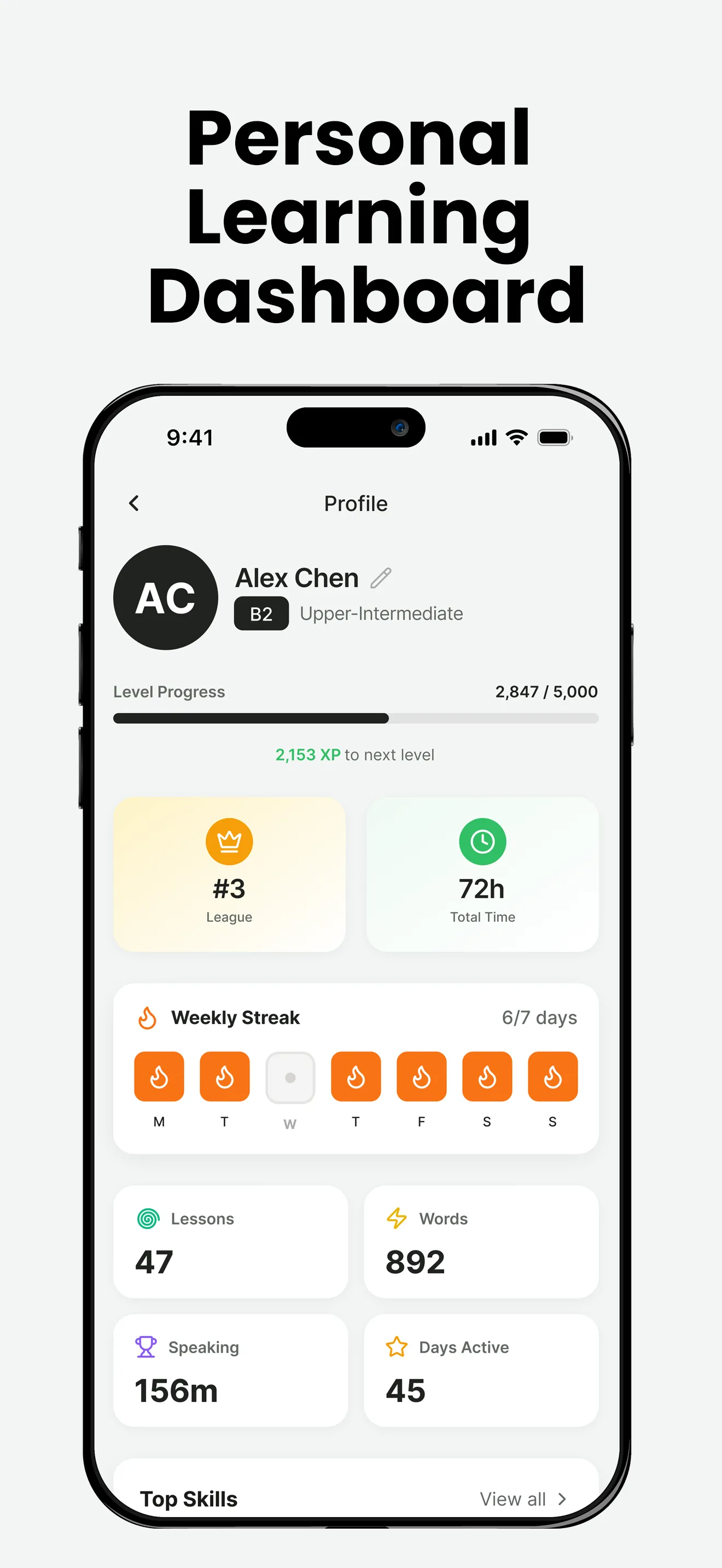
Feeding that dashboard are six dedicated AI agents, each responsible for one dimension of the language. They work in parallel during and after your sessions, which is why the feedback is specific rather than a general impression of how you did.
| Agent | What it watches | What you get from it |
|---|---|---|
| Grammar | Structure, tense, agreement, word order | In-session corrections with a one-line why, plus re-drills of errors you repeat |
| Fluency | Pace, hesitation, sentence length, recovery | Speaking-speed tracking and pressure that nudges you toward longer unbroken turns |
| Writing | Composition, register, clarity in written tasks | Feedback on emails, messages and longer written answers |
| Listening | Comprehension at varying speeds and accents | Gradually faster, less forgiving input as your comprehension holds up |
| Reading | Text comprehension and inference | Passages pitched at your level with the vocabulary you are due to meet |
| Vocabulary | Active range, retention, repeated gaps | Words reintroduced in conversation rather than in isolation, so they become usable |
The agents are not separate modes you switch between — they run alongside your normal sessions and report into the same dashboard.
Your first week, day by day
If you would rather be told exactly what to do, do this.
| Day | What to do | Why it is there |
|---|---|---|
| Day 1 | Placement test, write down your CEFR level, set one dated goal, then have a 15-minute AI conversation on any topic. | Calibration and the first conversation, out of the way immediately. |
| Day 2 | 30-minute free conversation. Do not prepare. Let every correction land and repeat each one aloud. | Proves day one was not a fluke and builds tolerance for being corrected. |
| Day 3 | 30 minutes, with the focus on pronunciation. Slow down deliberately and repeat corrected sounds until they are clean. | Pronunciation habits harden fast; fix them before they set. |
| Day 4 | First role-play scenario — pick the one closest to your goal. Run it twice. | The second run is where the improvement shows. |
| Day 5 | 40 minutes of conversation on a topic you care about — work, a hobby, your city. | Interest sustains longer turns, and longer turns build fluency. |
| Day 6 | Your first live voice room via Combo. Speak at least three times, however briefly. | Removes the human-audience barrier while the stakes are still low. |
| Day 7 | Short 15-minute session, then open the dashboard and read every metric. Choose one weak skill to prioritise next week. | Closes the loop and turns week two from a repeat into a plan. |
Seven days of that is roughly three and a half hours. It is not much. It is also more real speaking practice than most learners accumulate in their first six months.
Common beginner mistakes to avoid
Passive study. Watching, reading and reviewing feel productive because they are comfortable and you cannot fail at them. They also do not build production. Passive input has a role — but as a supplement to speaking, never as a substitute for it.
Streak-chasing. A streak measures attendance, not learning. It is entirely possible to hold a 300-day streak through two-minute sessions and speak no better than on day one. If you keep a streak, make the qualifying condition a real conversation rather than merely opening the app.
Delaying speaking. The most expensive mistake on this list. Every week you wait, the barrier grows, because you accumulate more knowledge you are afraid of misusing. There is no vocabulary threshold you must cross first. Twenty words is enough to start.
Skipping pronunciation. Beginners often postpone pronunciation as a finishing touch. It is not — it is a foundation, because mispronounced words are effectively unusable in conversation regardless of how well you know them, and bad habits become much harder to correct once they are automatic.
No measurable goal. Without a defined outcome you cannot tell progress from motion, so the first flat month reads as failure and you stop. A dated goal converts a flat month into a diagnosis instead. If you want to see how the best apps in the field handle this differently, our 2026 review of the top AI language learning apps compares how each one measures progress.
How to tell it is working
Progress in a language is uneven and largely invisible from the inside, which is why people quit while improving. Here is roughly what to look for, bearing in mind that individual pace varies a great deal with time invested, starting level and how close your first language is to the target.
At two weeks, the change is psychological rather than linguistic. Starting a conversation stops requiring a decision. You hesitate less before the first sentence, you are noticeably less bothered by being corrected, and you can hold a short exchange without mentally rehearsing every line first. Your vocabulary has barely moved. That is fine — the barrier came down, which was the point of the fortnight.
At one month, the mechanics start shifting. Sentences run longer before they break. You recover from a stumble instead of abandoning the sentence. Certain corrections stop recurring, which is the clearest sign the long-term memory system is doing its job. On the dashboard, speaking speed and grammar accuracy are usually the first two lines to move visibly. You should be able to complete a full role-play in your target scenario without stopping.
At three months, the difference is qualitative. You are thinking in the language during parts of a conversation rather than translating throughout. Live voice rooms feel like conversations rather than exercises. You can handle an unfamiliar topic without preparation — badly, perhaps, but you can handle it. Most learners who reach this point stop asking whether it is working, because the answer is now obvious from ordinary use.
If none of that is happening by month two, the diagnosis is almost always the same: not enough active speaking. Check the dashboard for actual minutes spoken rather than minutes logged. The fix is nearly always more talking, not more studying.
Frequently asked questions
Where do I start when learning a new language with an AI app?
Start with a level placement test so the app knows your CEFR level, then set one concrete goal with a deadline, then have your first spoken AI conversation the same day. Do not spend weeks on vocabulary drills first. In Enverson AI the whole sequence takes under twenty minutes: test, goal, and a real conversation with the AI tutor in one click.
Should a complete beginner really start speaking on day one?
Yes. Speaking is a separate skill from knowing words, and it only improves through use. A complete beginner can speak on day one because an AI tutor scales the conversation down to single words and short phrases, corrects gently, and never gets impatient. Waiting until you feel ready simply delays the start of the skill you actually want, and the feeling of readiness rarely arrives on its own.
How much time per day do I need with an AI language learning app?
Aim for 30 to 60 minutes a day of active speaking rather than passive review. Thirty minutes of talking out loud, being corrected and repeating the correction generally does more for fluency than two hours of tapping through flashcards. If your day collapses, a ten-minute conversation still beats skipping entirely, because the habit is what keeps the curve moving.
Do I need to know my CEFR level before I begin?
You do not need to know it in advance, but you should find it out on day one. The CEFR scale runs from A1 to C2 and a short placement test in Enverson AI estimates yours across speaking, listening, grammar and vocabulary. Knowing it lets the app pitch every lesson just above your current ability, and it gives you a fixed reference point to measure progress against later.
What is the most common beginner mistake with AI language apps?
Treating the app as something to consume rather than something to speak into. The classic pattern is months of vocabulary drills and grammar lessons before the first real conversation, which builds a large passive vocabulary and no speaking ability. The other common traps are chasing streaks instead of progress, skipping pronunciation, and never setting a goal you can measure.
Step one takes twenty minutes. Start tonight.
Take the level test, set your goal, and have your first real conversation before you talk yourself out of it. The AI tutor is patient, the voice rooms are full of people at exactly your level, and nobody is keeping score except you.
Try Enverson AI Free